
Why Certain BMWs Felt Intellectual Before They Felt Aggressive
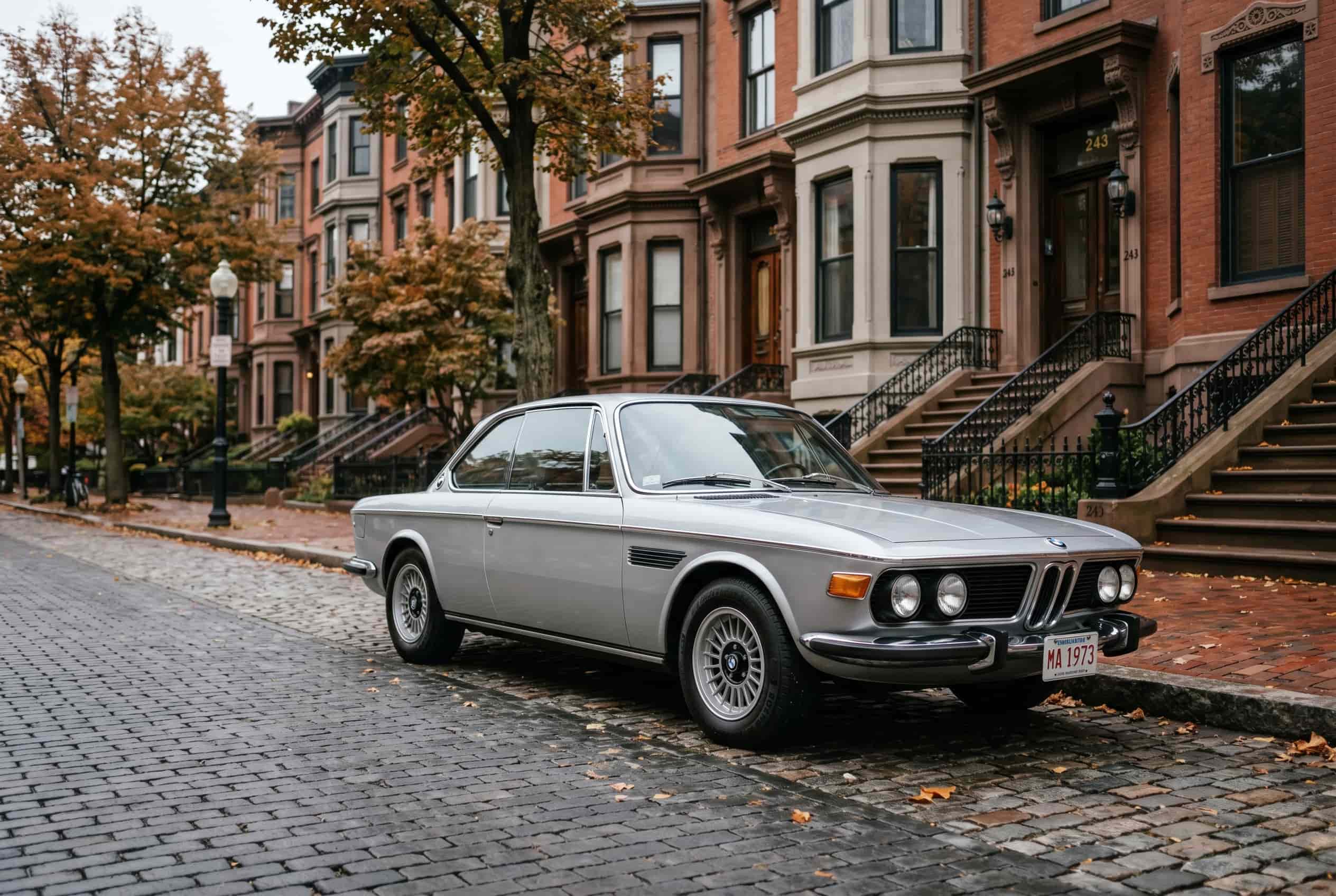
There is a photograph I keep returning to. It shows a 1973 BMW 3.0 CSi parked on a cobbled street in Munich, the car still new enough that its chrome reflects the gray winter sky without a single pit or blemish. A man in a wool overcoat stands beside it, keys in hand, not posing. He looks like an architect, or perhaps a professor of engineering. He is not smiling. The car is not either. And yet the image radiates a quality that modern BMWs have almost entirely abandoned: the suggestion that the machine was designed for someone who thinks, not someone who wants to be seen.
BMW spent decades building cars that felt intellectual. Not in the sense of being complicated—these were not difficult cars to operate—but in the sense that they seemed to have been conceived by minds that respected the mind of the driver. The controls required attention without demanding it. The engines rewarded precision without punishing error. The styling was taut, lean, and conspicuously free of ornament, as if the designers had decided that intelligence was the most attractive quality a car could project, and that decoration would only dilute it.
Then something changed. The kidney grilles began to swell. The exhausts began to crackle. The marketing began to speak less about engineering philosophy and more about dominance, adrenaline, and M badges. The intellectual BMW became the aggressive BMW, and the marque's relationship to its drivers shifted from a conversation to a declaration.
This essay is about what was lost in that transition—and why the older BMWs remain, for a certain kind of driver, the most complete expression of what the marque once meant.

The Architecture of a Thinking Car
The old BMWs were built on a philosophy that the company called Neue Klasse—New Class—when it rescued the marque from financial collapse in the early 1960s. The philosophy was straightforward: build a car that is lighter than it needs to be, more responsive than the price suggests, and entirely free of stylistic excess. The engineering led. The styling followed. The result was a series of sedans and coupes that looked the way good engineering drawings look: purposeful, resolved, and honest.
What made these cars feel intellectual was not any single feature. It was the cumulative effect of design decisions that trusted the driver to notice the right things.
The visibility. Old BMWs had thin pillars and generous greenhouses. The driver sat high relative to the beltline, with an uninterrupted view of the road and its surroundings. The car did not wrap around you like a helmet. It placed you in the landscape and asked you to read it. This is a fundamentally intellectual relationship to driving: you are gathering information, processing conditions, making judgments. The car supports the process rather than isolating you from it.
The controls. Everything the driver touched—the gear lever, the indicator stalk, the climate sliders—moved with a weight that communicated mechanical connection. The steering was heavy at parking speeds and alive at road speeds, transmitting the texture of the asphalt through a thin-rimmed wheel. There was no sport mode, no adjustable damping, no configurable throttle mapping. The car had one character, and it was the driver's job to learn it.
The engine. BMW's inline-six engines of this era were not the most powerful in their class. They were the smoothest. They revved with a turbine-like eagerness, pulling cleanly from idle to redline without flat spots or histrionics. The pleasure was not in the shove but in the willingness—the sense that the engine was always ready, always balanced, always eager to do more than was strictly necessary.
The Driver as Participant, Not Customer
These qualities produced a particular kind of relationship between car and driver. The old BMW did not flatter you. It did not tell you that you were a hero for taking a corner at speed. It simply responded to your inputs with precision, and if your inputs were clumsy, the car let you know. Not by punishing you—these were forgiving cars in the sense that they did not bite—but by withholding the extra layer of fluidity that came when you got it right.
This is what I mean by an intellectual car. It treats driving as a skill to be developed, not a sensation to be consumed. It respects the driver enough to require something from them. It does not fill the cabin with artificial engine noise or synthesize a throttle map that makes you feel faster than you are. It gives you the machine as it is, and trusts that you will rise to meet it.
Table: The Intellectual BMW vs. The Aggressive BMW
Element | Intellectual BMW (1960s-1980s) | Aggressive BMW (Current Era) |
|---|---|---|
Grille | Small, kidney-shaped, proportionate, chrome-framed | Oversized, vertically stretched, often illuminated or blacked out |
Engine character | Smooth, eager, linear, rewardingly mechanical | Powerful, turbocharged, sometimes synthesized in-cabin |
Steering feel | Heavy, communicative, unassisted or lightly assisted | Adjustable, electronically weighted, often filtered |
Cabin design | Driver-angled, minimal, analog, outward-focused | Screen-dominant, configurable ambient lighting, technology-showcase |
Relationship to driver | Demands skill, rewards learning, treats driving as a craft | Offers configurability, rewards purchase level, treats driving as an experience |
Exterior language | Taut, understated, glassy, free of ornament | Muscular, creased, vented, visually loud |
Sound | Mechanical, honest, heard in the cabin as a byproduct | Engineered, amplified, sometimes played through speakers |
Market position | Engineering-led, built for those who read road tests | Image-led, built for those who lease |
The cars on the left of this table were not slow. An E9 CSi, a 2002tii, an E28 M5—these were quick cars by the standards of their day. But speed was not their primary identity. Their primary identity was intelligence. They were cars that seemed to understand what you wanted before you had fully articulated it, and they delivered it without drama.
What the Grille Tells You
No design element captures the transformation more completely than the kidney grille. On the original Neue Klasse sedans, the kidneys were small, vertical, and integrated into a forward-leaning nose that suggested forward motion without aggression. They were a signature, not a statement.
On the current BMW lineup, the kidneys have expanded to dimensions that are frankly surreal. They dominate the front fascia. They are frequently outlined in illumination. They have become the car's primary visual identity, eclipsing the proportions, the stance, and the detailing that once defined the marque. The grille no longer identifies the car. It is the car.
This is not merely an aesthetic misjudgment. It is a philosophical reversal. The old BMW was designed so that you would see the whole machine—its stance, its glass, its restraint—and only later register the grille. The new BMW is designed so that you see the grille first, and the rest of the car fades into secondary importance. The old car trusted your eye. The new one fears it will wander.
The E28 and the Last of the Thinkers
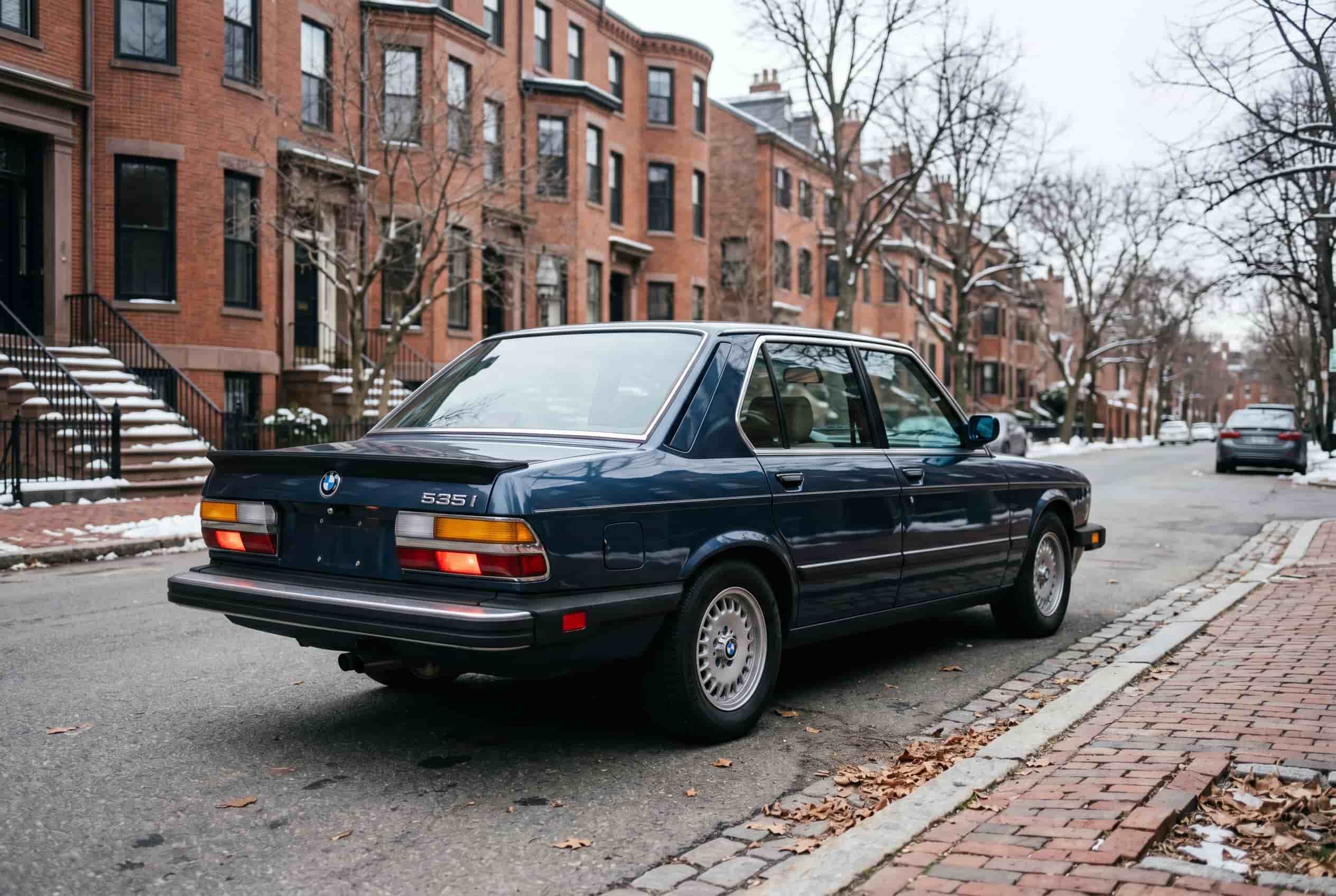
If I had to choose one car that embodies the intellectual BMW before the shift, it would be the E28 5 Series. Built from 1981 to 1988, it was the second generation of the 5 Series and the last one designed before the marque began its long pivot toward the performance-luxury arms race that defines it today.
The E28 was not beautiful in the way a Jaguar XJ was beautiful. It was beautiful in the way a good tool is beautiful. Every line had a job. The front overhang was short because the engine sat behind the front axle. The glass area was large because visibility was a safety feature and a driving pleasure. The cabin was angled slightly toward the driver because BMW still believed that the person behind the wheel was the most important person in the car.
Driving an E28 today is a revelation. The steering is heavy at low speeds, communicative at all speeds. The M30 inline-six pulls with a creamy, unhurried authority that never feels strained. The cabin is quiet but not silent—you hear the engine, the tires, the wind, in proportions that feel honest rather than engineered. There is no screen. There are no modes. There is simply the car, the road, and your own judgment. The E28 does not tell you how to drive it. It expects that you already know.
What Was Gained, What Was Lost
I am not going to pretend that modern BMWs are bad cars. They are, by almost any objective measure, extraordinarily capable. They are faster, safer, more efficient, and more technologically advanced than their predecessors. An M340i will cover ground at a pace that would leave an E28 gasping. That is not in dispute.
But capability is not identity. The old BMWs had an identity that transcended their performance figures. They were cars for people who enjoyed the act of driving as a form of thought—people who read road tests, who understood weight distribution, who chose a car not because of what it projected but because of what it required. The new BMWs are cars for people who want to be seen driving, and who want the car to do most of the thinking for them.
The marque gained market share. It gained lap times. It gained a presence in every premium lease portfolio in the Western world. But it lost the thing that made it matter to a certain kind of driver: the sense that the car was not a statement, but a conversation partner. That it thought. That it respected the fact that you thought, too.
An Afternoon with an E28
I drove an E28 535i last autumn, borrowed from a man in Cambridge who has owned it for twenty-two years. The car was not perfect. The odometer had stopped at 187,000 miles a decade ago. The driver's seat bolster was worn through. The gear lever had a slight vibration at idle that the owner described, without irony, as "part of the experience."
I drove it west into the hills, on roads I knew well enough to judge a car by. Within fifteen minutes, I understood what I had been trying to write about for months. The car did not demand anything. It did not shout. It did not crackle. It simply flowed, with a mechanical transparency that made every input and response feel like a sentence in a shared language. When I steered, the car answered. When I braked, the car settled. When I accelerated out of a corner, the rear tires loaded up and the car pushed forward with a quiet, insistent competence that felt like being understood.
I did not record the drive. I did not photograph the car. I returned it, thanked the owner, and drove home in my own vehicle, thinking about what it means when a machine leaves you feeling smarter than you were when you got in. That is not a sensation any modern BMW I have driven has produced. It is the sensation that defined the marque for thirty years. And it is gone.