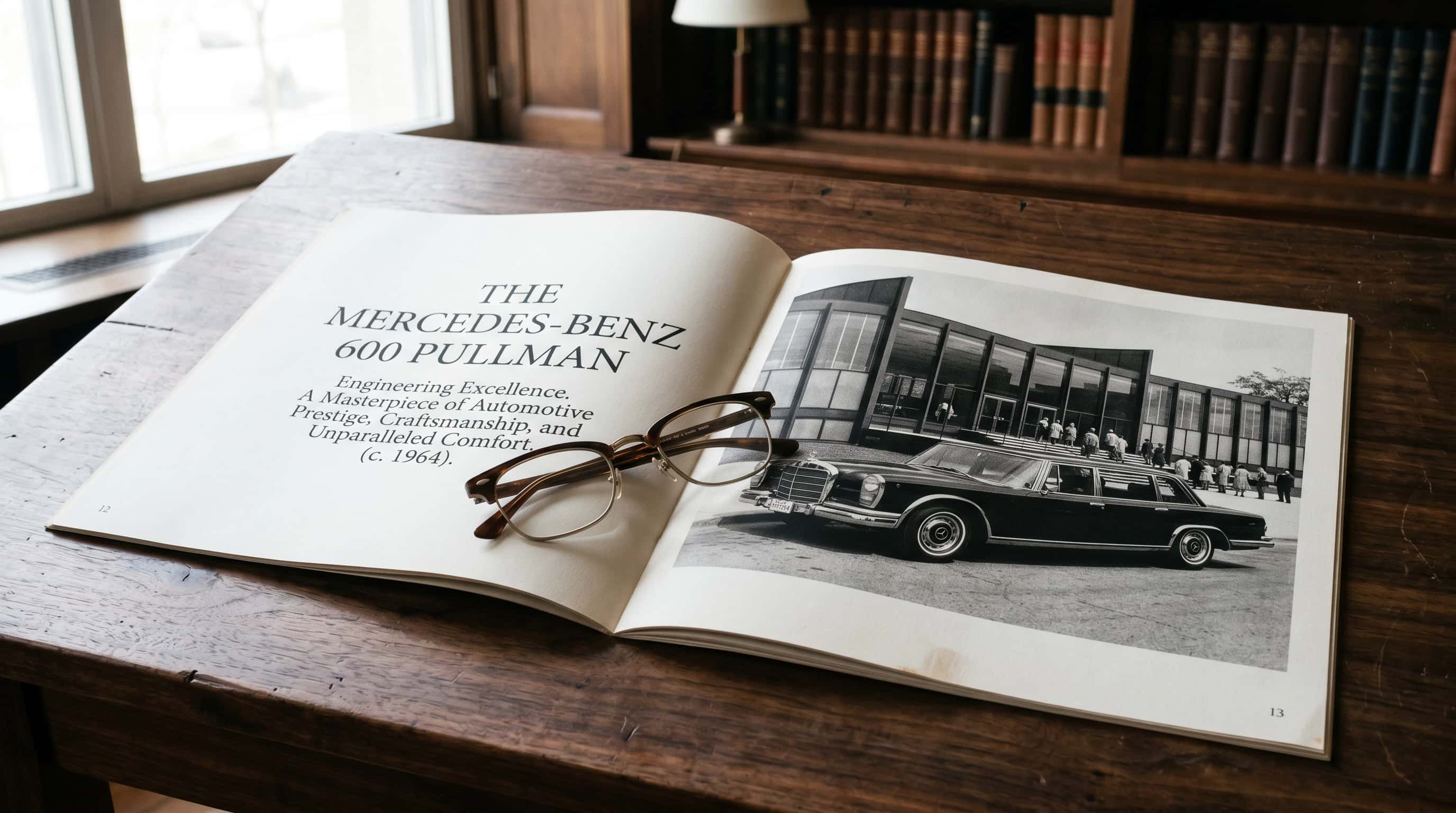
The brochure arrives in the post in a stiff manila envelope, or it is handed across a dealer’s desk with the quiet formality of a book being presented. The cover says nothing more than the marque and the model name. Inside, the paper is heavy and uncoated, the ink has a faint raised texture where the letters have pressed into the fiber, and the photographs are composed with the deliberation of architectural plates. There are no exclamation points. There are no asterisks leading to fine-print disclaimers. There is a car, described with the conviction that the car is enough.
I collect these documents. Not as investments—their value on the auction market is erratic—but as artefacts of a confidence that the automobile industry has almost entirely lost. A 1960s Mercedes brochure, a 1970s Lancia catalog, a 1950s Citroën booklet: each one is a window into what a manufacturer believed about its own product and about the person who would read about it. That belief, I have come to think, is the difference between a marque that knows what it is and a marque that is hoping you will tell it.
The Photography That Does Not Chase You
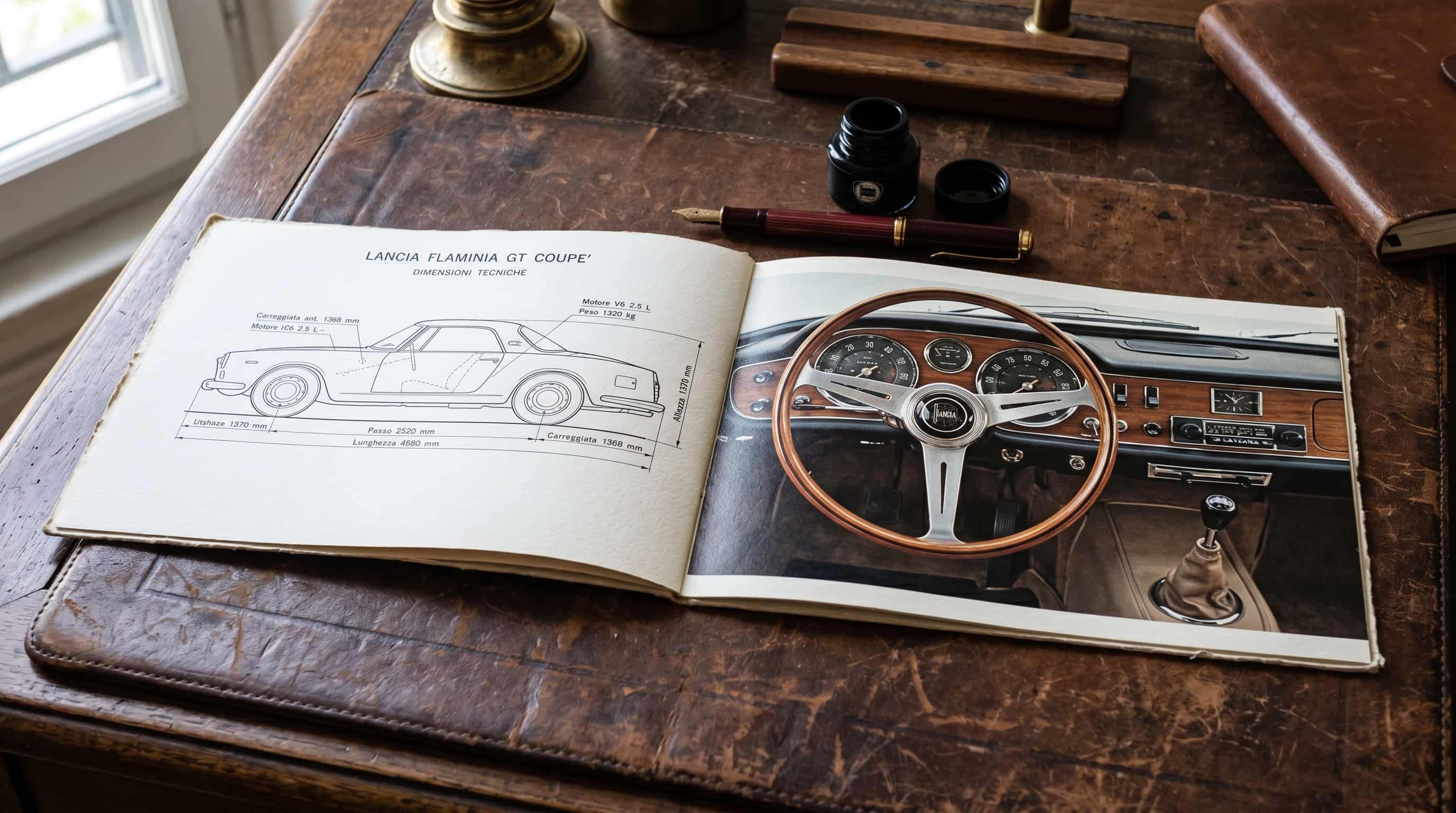
The first thing you notice about an old brochure is the stillness of its images. The car is parked. It is not cornering at speed, not captured in a blur of motion, not shot from a helicopter over a desert road. It is simply there, often in front of a building or a landscape, and the composition allows you to study it. The side profile is shown without distortion, because the manufacturer trusted the proportion enough to present it flat. The interior is photographed with the door wide open and the light falling evenly across the seats, because the materials were expected to stand up to scrutiny.
This stillness is a form of confidence. The car is not being sold as a thrill or an escape. It is being presented as an object of consideration, something you might return to after dinner and look at again. The implicit message is that you, the reader, are a person of patience and judgment. You do not need to be shouted at or dazzled. You need to be informed, and the brochure assumes that information, beautifully delivered, is the most persuasive tool available.
Modern car photography has inverted this entirely. The default mode is motion blur, a drone angle, a vehicle canted dramatically on an apex. The car is almost never still, because stillness would invite the kind of scrutiny that modern design, with its overwrought surfaces and unresolved proportions, often cannot survive. The old brochure trusted you to look. The modern image is afraid you will stop.
The Language of Equals
If the photography was composed for a patient eye, the language was written for a literate one. Old automotive brochures routinely used words that would never survive a modern marketing committee. They described engine internals. They explained suspension geometry. They named the designer. They assumed that the reader either understood terms like “camber change” and “valve overlap” or was willing to learn.
A 1963 Mercedes-Benz 600 brochure dedicates several pages to the hydraulic system that powers the windows, seats, sunroof, and trunk lid. It explains the pump, the reservoir, the circuit logic. It does not apologize for the complexity. It presents complexity as evidence of commitment, and it assumes the buyer will find commitment more persuasive than slogans.
This is the language of equals. The manufacturer is addressing a reader it respects—someone who has done research, who may have owned the previous model, who is capable of making a decision on the merits. The brochure’s job is not to seduce or overpower. It is to provide the information that a serious person would require, in a tone that a serious person would recognize.
The modern product page, by contrast, addresses a reader it fears. The language is superlative without substance. Words like “iconic,” “game-changing,” and “premium” are deployed as padding because the product cannot be trusted to make its own case. The copy is short, because the assumption is that the reader will not read. It is interrupted by pop-ups for chat assistants and trade-in valuations, because the assumption is that the reader is about to leave. The old brochure assumed you would stay. The modern page assumes you are already gone.
Table: The Brochure as a Measure of Marque Confidence
Element | Old Brochure (Confident) | Modern Equivalent (Anxious) |
|---|---|---|
Photography | Static, composed, lit to reveal form | Motion blur, drone angles, dramatic skies |
Typography | Serif, high-contrast, well-spaced | Sans-serif, neutral, optimized for mobile |
Copy tone | Technical, descriptive, respectful | Superlative, urgent, search-engine-optimized |
Paper and production | Heavy uncoated stock, letterpress or fine offset, designed to be kept | Website with loading animations, designed to be scrolled past |
Assumption about reader | Patient, informed, capable of judgment | Impatient, distractible, in need of guidance |
Time horizon | The brochure was intended to be kept for years, sometimes decades | The page is relevant until the next model-year refresh |
Call to action | A dealer address, a telephone number | A pop-up, a chat window, a countdown timer |
The Object That Stays
The physicality of an old brochure is itself an argument. The paper weight, the binding, the absence of a price tag printed on the cover—these things communicated that the document was worth keeping. Many owners did keep them. I have found brochures tucked into the gloveboxes of cars that changed hands three times, each owner preserving the document alongside the service records. The brochure was part of the car, not an advertisement that expired once the sale was complete.
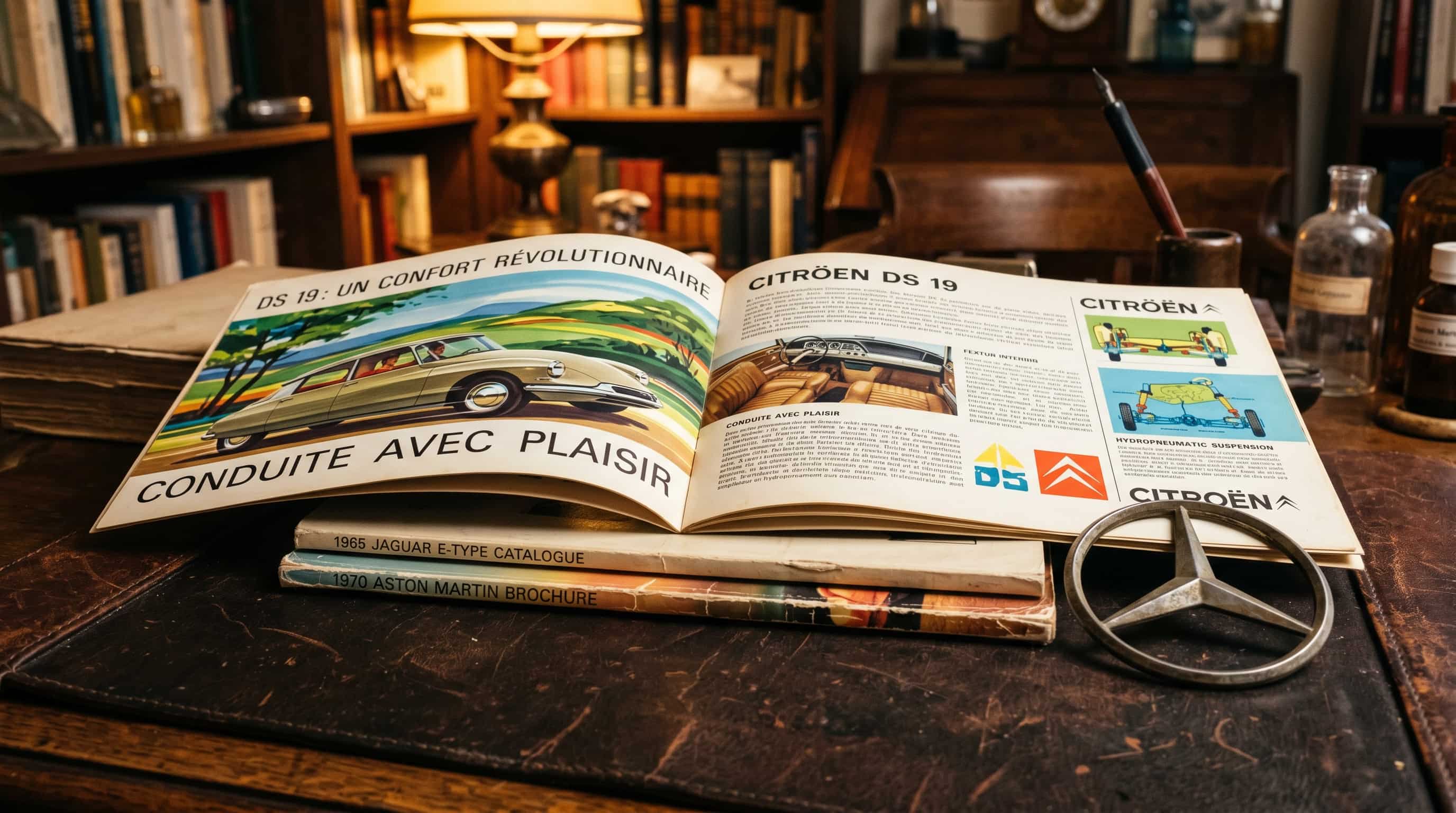
This permanence shaped the design. A 1950s Citroën DS brochure is a piece of graphic design that happens to be about a car. The layout is modernist, the color palette restrained, the use of negative space as deliberate as the car’s own shape. You could frame one of these pages and hang it on a wall, and people would ask about the artist. That the artist was a team working for a manufacturer is the point. The manufacturer believed its product merited the same attention as a gallery piece. And because it believed that, it produced a document that still holds the wall decades later.
The modern equivalent—a PDF download, a website gallery, a configurator—is designed to be ephemeral. It lives on a screen, occupies no physical space, and vanishes when the browser tab closes. There is nothing wrong with efficiency. But efficiency is not confidence. Confidence is the willingness to print ten thousand copies of a booklet that costs more per unit than most marketing departments would approve today, because you believe the car is worth the paper it is printed on.
What We Lost When Brochures Went Away
I am not nostalgic for the past as a matter of principle. Digital tools have made it possible for small marques and independent designers to share their work with a global audience at negligible cost. That is a genuine gain. But the disappearance of the printed brochure as a standard practice represents a specific loss: the loss of the manufacturer’s willingness to make a permanent case for its own product.
A printed brochure was a statement of accountability. It could not be updated after publication. It could not be A/B tested and revised based on click-through rates. It had to be right when it went to press, because any error would sit in the owner’s library for decades, a silent reproach. This demand for finality enforced a discipline that the iterative, endlessly updatable digital product page has never had to develop.
The confident brochure also created a relationship that the modern marketing funnel cannot replicate. The reader requested the brochure, or accepted it from a dealer. The reader opened it, turned the pages, and absorbed it at their own pace. The relationship was opt-in, deliberate, and private. The modern car shopper is pursued across devices, retargeted with ads for the same vehicle they already configured, and offered a chat window before they have finished reading the first paragraph. The old relationship was built on invitation. The new one is built on pursuit. Invitation is confident. Pursuit is not.
A Quiet Archive
I keep my collection of brochures on a shelf in my study, organized by marque and era. They are not behind glass. They are meant to be handled. When I want to understand what a manufacturer thought of itself in 1968, I pull the appropriate booklet, open it to the foreword—there was always a foreword—and read.
What I find, almost always, is a version of the marque that believed it was building something for someone who would keep it. The confidence is palpable. It is in the typeface. It is in the paper. It is in the unapologetic length of the technical descriptions and the refusal to summarize a beautifully engineered suspension as “class-leading handling.” It is in the assumption that the reader is a participant in the marque’s story, not a target waiting to be converted.
That confidence is not dead. It survives in the few manufacturers that still produce printed materials worth keeping, and in the collectors and writers who treat the old brochures as primary sources rather than curiosities. But it is no longer the default. It has been replaced by a marketing culture that does not trust its own products to hold attention, and therefore tries to seize it by any means available.
The old brochures knew that the best cars do not demand attention. They keep it. And a document that keeps your attention for fifty years, in a quiet corner of a quiet room, is as close as any brochure has ever come to being a car itself.