
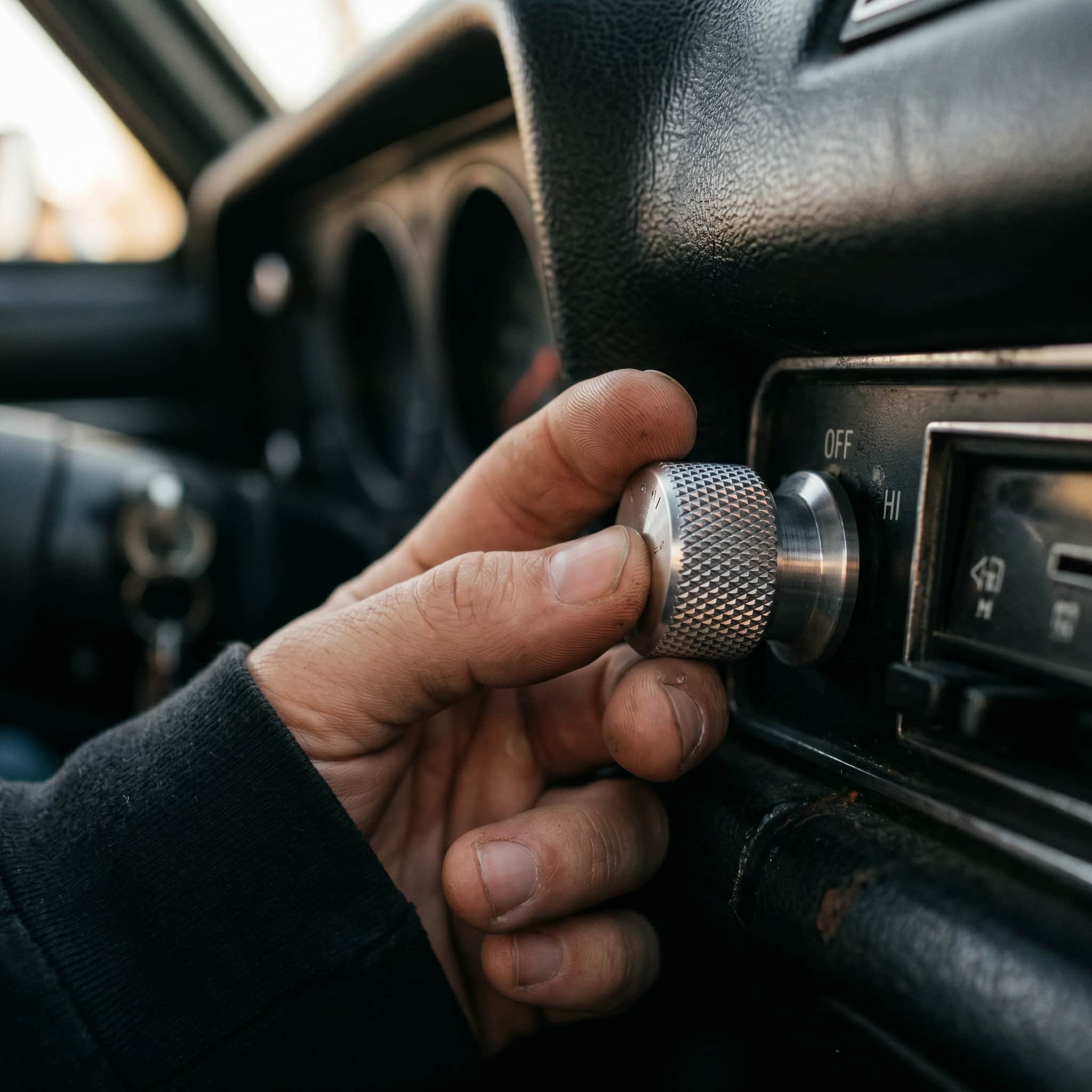
The first thing I do when I sit in an unfamiliar car is not to start the engine. It is to touch the controls. My hand goes to the climate knob, the volume dial, the indicator stalk, the window switch. I turn things, press things, slide things. I am not testing for functionality. I am testing for character. A machine that has been built with care will communicate that care through the things you touch, and it will communicate it before the engine fires.
There was a time when this communication was a standard part of automotive design. The controls in a well-made car were machined, weighted, and tuned with the same attention that a watchmaker applies to a crown. They clicked at the end of their travel. They resisted just enough to confirm that an action had been taken. They could be operated by feel, without a single glance away from the road, because the designer understood that the driver's visual attention was precious and that touch was a sense capable of far more than most interfaces allow.
That time is largely over. The analog control has been replaced by the touchscreen, the capacitive slider, the haptic pad that buzzes unconvincingly under your fingertip. This is sold as progress. I think it is a retreat from one of the most elegant relationships between human and machine that the twentieth century ever produced.
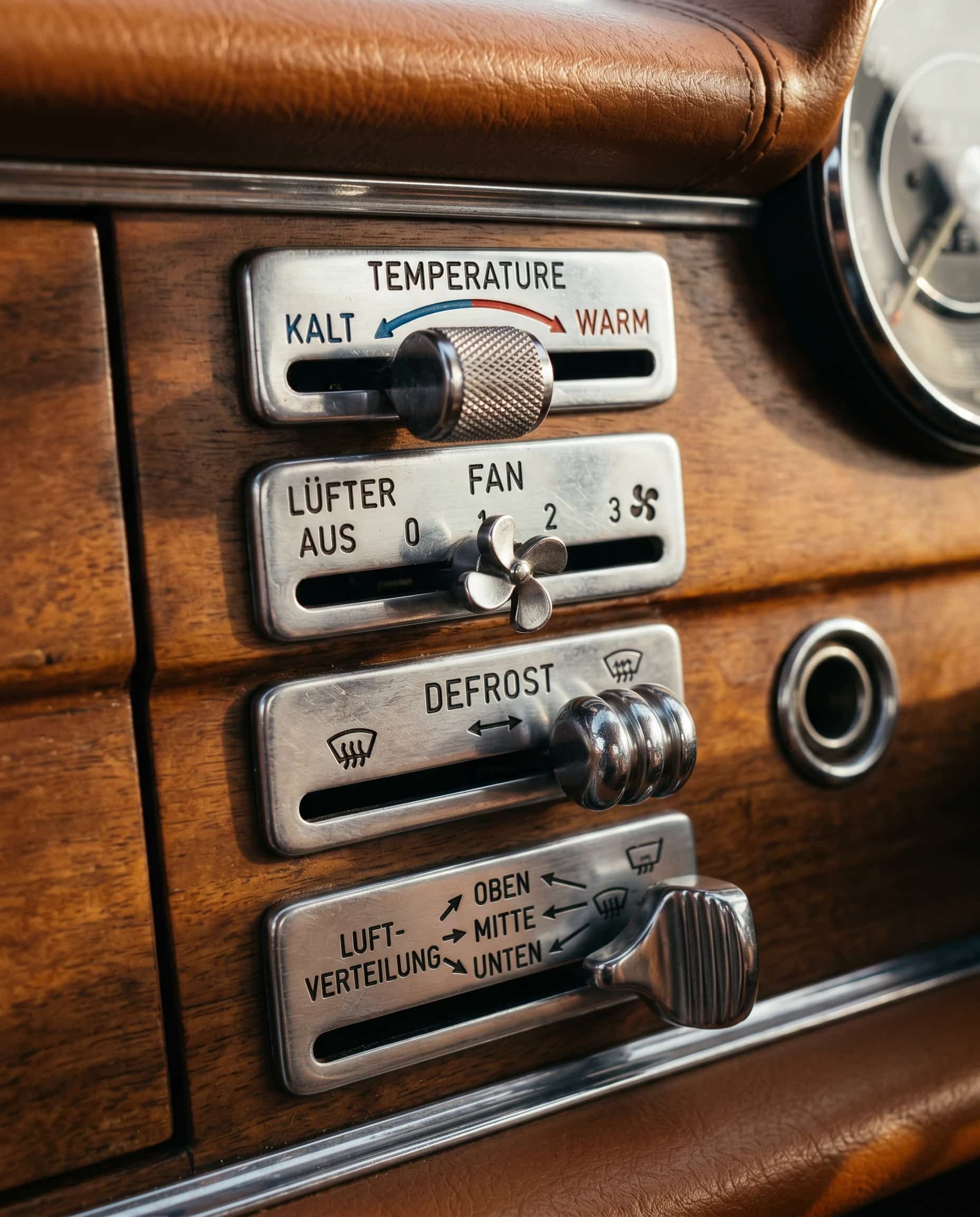
The Language of Touch
The analog control spoke a language that the touchscreen cannot. It spoke through resistance, travel, detents, and stops. Each of these was a word.
Resistance told you that the mechanism was deliberate. A volume knob that required a small but definite torque to rotate was saying: I will not change by accident. What you are about to do matters. A climate slider that moved smoothly but firmly through its range was saying: There is a position for every season, and you will find the one you want. A toggle switch that snapped cleanly into position was saying: This is on. Now this is off. There is no ambiguity. There is no menu.
The end of travel was particularly eloquent. A knob that reached a soft stop and refused to turn further communicated finality. You had reached the limit. No further adjustment was possible, and none was needed. This is a sensation that no touchscreen can replicate, because the touchscreen has no stops. It is an infinite surface of possibilities, none of which ever quite resolves. The driver is left in a permanent state of uncertainty: Did I press it? Did it register? Do I press again?
The old controls did not ask these questions. They answered them, once, through the mechanical certainty of a well-made switch.
The Three Virtues of the Analog Interface
I have identified three qualities that the best analog controls possessed, and that the modern digital interface has almost entirely abandoned. Each is a form of respect paid to the driver by the machine.
First, tactility without vision. A knob with a distinct shape, a slider with a textured grip, a rocker switch with a positive detent—all of these can be operated without looking. The driver's hand learns where they are and what they feel like. Within a week of regular use, the relationship becomes automatic. The driver adjusts the temperature the way a pianist finds middle C: by feel, instantly, without the conscious mind intervening.
This is not merely convenient. It is a safety consideration of the first order. Every glance at a screen to adjust the fan speed is a glance not taken at the road. The old controls kept the driver's eyes where they belonged. The new ones demand them, repeatedly, for the most routine operations. This is not progress. This is a regression dressed in glass.
Second, hierarchy through form. The analog dashboard was an exercise in visual and tactile hierarchy. The volume knob was larger than the balance knob. The light switch was shaped differently from the wiper switch. The climate controls had sliders with different profiles for temperature and fan speed. The driver could navigate the entire center stack by touch alone because no two controls felt the same.
This differentiation was not decorative. It was functional. It recognized that the hand has a memory, and that the hand's memory is faster than the eye's. The modern flat surface, with its identical icons and uniform touch zones, denies the hand any purchase. Everything feels the same because everything is the same: a glass rectangle with software behind it. The hierarchy has been flattened into a single plane of endless, interchangeable gestures.
Third, permanence of position. The analog control stayed where it was. The volume knob was always to the left of the climate controls, or above them, or wherever the designer had placed it, but it was always there. The driver learned its position once and never had to relearn it. The modern touchscreen reorganizes itself constantly. Menus shift. Icons relocate. Updates rearrange the interface overnight. The driver never truly learns the layout because the layout is never truly finished.
Permanence of position is a form of loyalty. The machine says: I will not change on you. You can trust me to be where I was yesterday. The touchscreen says: I might be different tomorrow. Keep watching.
Table: Analog Tactility vs. Digital Ambiguity
Quality | Analog Control | Digital/Touchscreen Equivalent |
|---|---|---|
Feedback | Mechanical detent, audible click, physical stop | Haptic buzz, visual change, no mechanical certainty |
Operability without vision | Full; shape, position, and texture guide the hand | Minimal; requires visual confirmation for most actions |
Learning curve | Short; muscle memory develops within days | Long; muscle memory is undermined by software updates and menu reorganization |
Error rate | Low; the control does what it feels like it will do | Higher; unintended touches, double-taps, and gesture confusion |
Durability | Decades; contacts can be cleaned, knobs can be replaced individually | Years; screens delaminate, touch sensitivity degrades, entire panels must be replaced |
Relationship to driver | The driver commands the machine | The driver negotiates with the interface |
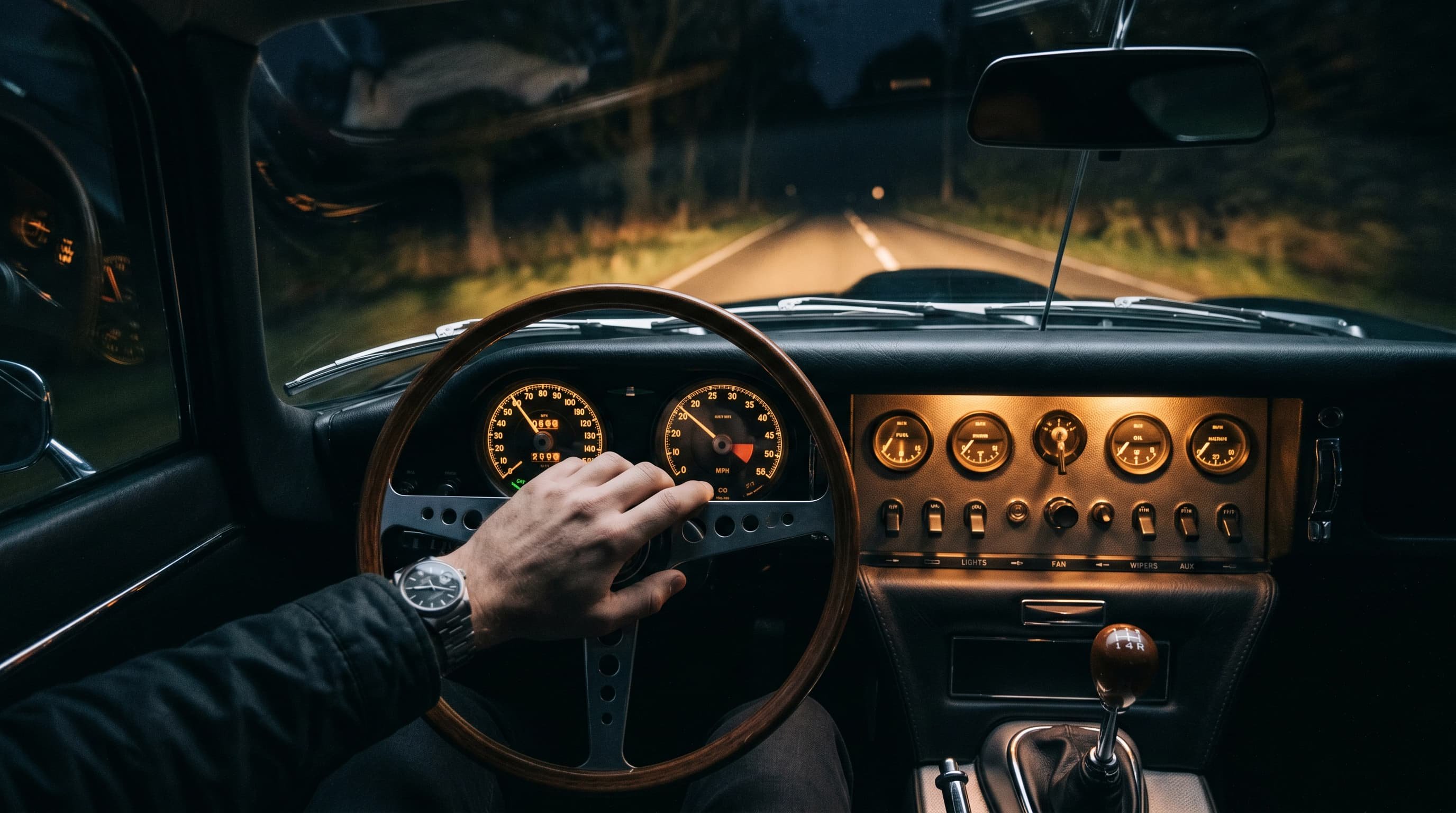
What the Screen Took
The migration from analog to digital was not a single decision. It happened incrementally, one function at a time. The radio went first, replaced by a touchscreen infotainment system that promised navigation, streaming, and voice control. Then the climate controls moved behind the glass. Then the instrument cluster became a screen. Then the buttons on the steering wheel became touch-sensitive pads with haptic feedback that worked most of the time. Each step was sold as an upgrade. The cumulative effect was a loss.
What was lost was not merely a set of controls. It was a relationship. The analog interface treated the driver as a body with hands, ears, and muscle memory. The digital interface treats the driver as a pair of eyes attached to a brain that processes menus. The first relationship is embodied, intuitive, and leaves the mind free for the act of driving. The second is abstract, cognitive, and competes with driving for the same mental resources.
This competition is the part that no manufacturer's press release addresses. A touchscreen menu for adjusting the seat heating requires the same visual processing system that is supposed to be tracking the road. It occupies the same neural bandwidth. The driver who is navigating three levels of climate submenus is, for those moments, not fully driving. The analog control never created this conflict. It used a separate channel—touch—and left the visual system undisturbed.
The Honesty of the Switch
There is a final quality to the analog control that is harder to name but easy to feel. It is the quality of honesty. A physical switch is what it appears to be. It moves. It clicks. It completes a circuit. The relationship between the action and the result is direct, physical, and cannot be faked.
The touchscreen is not honest in this sense. The button you see on the screen is not a button. It is an image of a button, generated by software, and the software is free to ignore your touch, delay your touch, or interpret your touch as something other than what you intended. The relationship between the action and the result is mediated by code, and the code is invisible to you. You cannot inspect it. You cannot trust it the way you can trust a switch.
This matters because driving is an activity that demands trust. You trust the brakes to stop the car. You trust the steering to turn the car. You should be able to trust the volume knob to lower the volume. When the controls become software, they become subject to glitches, updates, and the priorities of a product manager who has decided that showing you a notification is more important than respecting your touch. The analog control did not have product managers. It had engineers, and the engineers answered to physics.
A Quiet Case for the Physical
I am not arguing that cars should return to carburetors and distributor caps. I am arguing that the interface between the driver and the machine should be designed for the driver's body, not for a software demonstration in a showroom. The analog control achieved this. It recognized that the human hand is a sensitive, intelligent instrument, and it gave the hand work worth doing.
The click of a well-made switch is a small thing. It lasts a fraction of a second. It is over before you have consciously registered it. But it is a fraction of a second in which the machine and the driver are speaking the same language, directly, without translation. That language is not dead. It survives in the few new cars that still use physical controls for essential functions, and in the old cars that I drive and write about. But it is endangered, and its replacement is not a richer vocabulary. It is a glass screen and a haptic vibration that feels like a lie.
The lost elegance of analog controls is not just about nostalgia for knobs. It is about the slow replacement of touch with vision, certainty with ambiguity, and permanence with flux. It is about the transformation of the driver from a participant in a machine to a user of an interface. The two are not the same. And the difference is something you can feel, every time your hand reaches for a switch that is no longer there.