
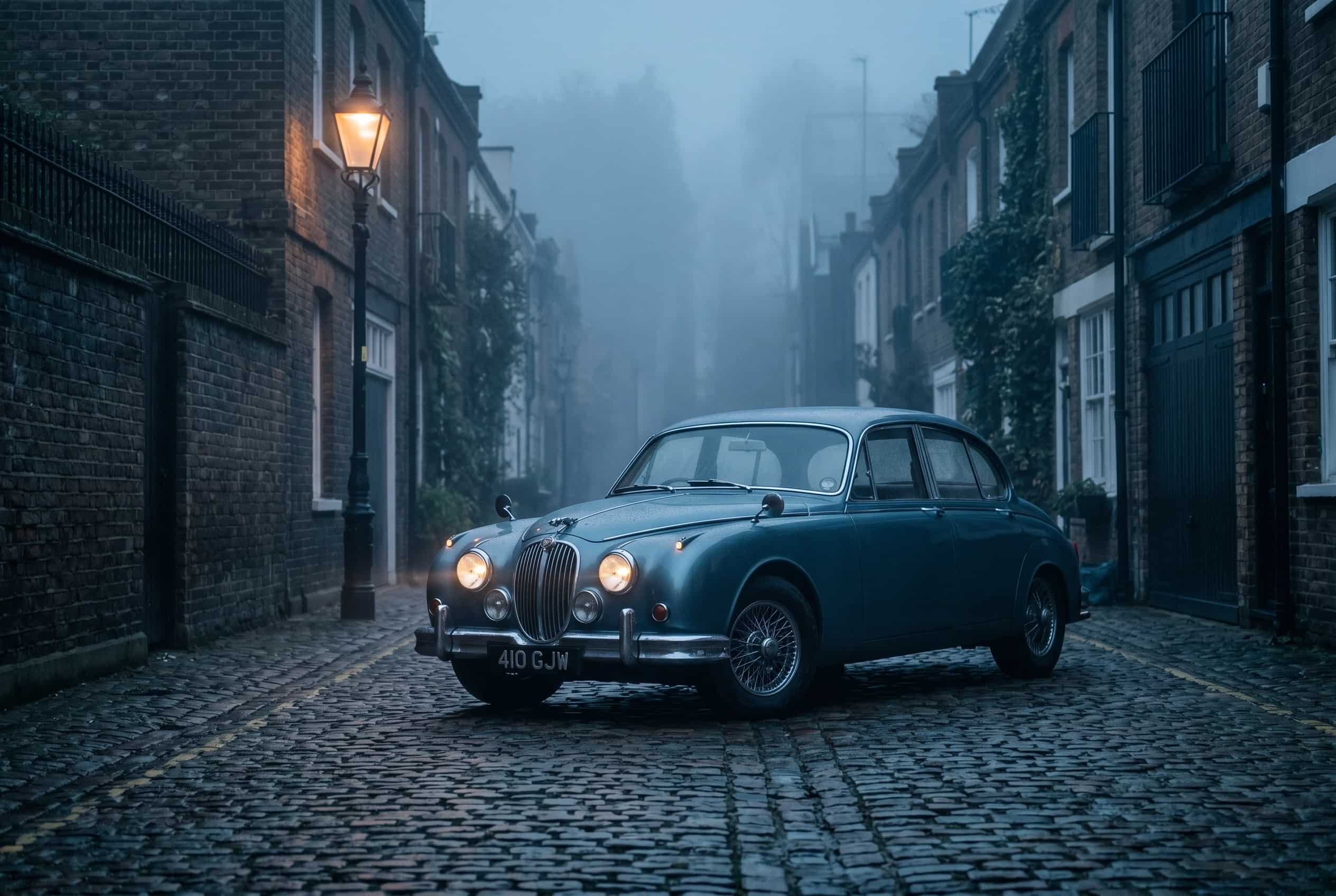
There is a photograph I think about often. It shows a 1961 Jaguar Mark II parked on a cobbled street in what must be early morning. The car is dark, the chrome is modest, the wire wheels are slightly dirty from a recent rain. A man in a dark overcoat leans against the driver's door, not posing but waiting, and he is not looking at the camera. He is looking down the street, toward something we cannot see. The car is not loud. The car is not aggressive. And yet the photograph vibrates with a particular kind of menace—the kind that comes from things that do not need to announce themselves.
That was Jaguar before noise. It was a marque that understood the difference between threat and theater, between power and performance, between the elegance that unsettles and the volume that exhausts. For roughly thirty years, from the XK120 through the Series 3 XJ6, Jaguar built cars that communicated danger through restraint. Then it forgot how. The exhausts grew louder, the styling grew angrier, and the quiet menace that had defined the marque was replaced by something that looked like a mood board assembled by people who had never actually been threatened by anything.
This essay is not a history. It is an argument for what was lost, and why it mattered.

The Two Jaguars
To understand what Jaguar was, you have to understand that there were always two versions of the marque operating simultaneously. The first was the Jaguar of the boardroom and the balance sheet—a company that built cars to a price, wrestled constantly with quality control, and survived by offering style and speed at a cost that undercut its rivals by a third. The second was the Jaguar of the imagination—the car that appeared in the mind when someone said the name.
The first Jaguar was a commercial enterprise. The second was a cultural one. And the second was the one that mattered.
The cultural Jaguar was the car driven by bank robbers and the detectives who chased them. It was the car parked outside the jazz club at three in the morning, its engine still warm, its occupants nowhere to be seen. It was the car that suggested its driver had access to pleasures that the respectable world could not provide. The Mark II, in particular, carried this association so strongly that it became a cinematic shorthand: show a Mark II pulling up to a curb, and the audience already knew that someone in that car was not to be trusted, and also that they were going to be the most interesting person in the scene.
This was not a marketing achievement. It was an achievement of character. The car looked the way certain people look—people who do not raise their voices because they do not need to.
The Grammar of Quiet Threat
The quiet menace of the old Jaguar was not an accident of period styling. It was the result of specific, repeatable design decisions that the marque maintained across multiple models and decades. Once these decisions are named, you begin to see them everywhere in the cars that worked.
Proportion as posture. The Mark II and the XJ6 share a proportional discipline that is almost feline. The hood is long, the cabin is set back, the rear overhang is modest, and the tail tucks under rather than jutting out. The car does not crouch. It leans back slightly, like a man who has just settled into a chair and is waiting for you to say something interesting. This posture communicates confidence without aggression. It is the stance of someone who knows they are faster than you and does not feel the need to prove it.
The face that withholds. The grille of an old Jaguar is not large. It is a slim oval, framed in chrome, positioned low on the nose. The headlights are round and widely spaced. The overall expression is not angry. It is watchful. The car seems to be regarding you with a patience that could, at any moment, turn into something else. This is the opposite of the modern performance face, which tries to intimidate through sheer size. The old Jaguar face did not try. It simply waited.
The cabin as private chamber. Inside, the old Jaguars were unlike anything else at their price. The dashboard was a continuous sweep of walnut, the instruments were deep-set and individually hooded, the leather smelled like a club library. The cabin was not designed to showcase technology. It was designed to create atmosphere. It was a room for two people to have a conversation that no one else would hear. The privacy of the space was part of the menace. What happened inside a Jaguar was not for you to know.
What the Noise Replaced
The shift did not happen all at once. It crept in over decades, as Jaguar's ownership changed, as the market expanded, as the focus groups began to report that buyers in certain regions wanted their cars to look more like they were going fast even when they were stationary. The design language that had once said "watchful" began to say "look at me." The exhaust note, once a refined murmur with a suggestion of power in reserve, became a crackling, popping theater designed to draw attention at every downshift.
This is the central loss: the replacement of suggestion with statement.
The old Jaguar suggested. It suggested speed. It suggested danger. It suggested that its driver had access to experiences that were not available to everyone. It did not state these things. It left space for the observer to wonder, and wondering is more powerful than knowing.
The modern Jaguar states. It states its horsepower in large numerals on the trunk lid. It states its intentions with an exhaust note that can be heard three blocks away. It states its aggression with intakes, vents, and diffusers that leave nothing to the imagination. The car has become a billboard for its own specifications. The suggestion is gone. The noise has replaced it.
Table: Suggestion vs. Statement in Jaguar Design
Element | Jaguar Before Noise (Mark II, XJ Series 1) | Jaguar After Noise (Current Era) |
|---|---|---|
Grille | Slim, oval, modest, chrome-framed | Larger, wider, sometimes blacked out or meshed |
Stance | Leaned back, patient, feline | Crouched forward, urgent, predatory |
Exhaust sound | Muffled purr with reserve, heard inside as a quality | Engineered crackle and pop, designed for bystanders |
Body surfacing | Smooth, taut, minimal ornament | Creased, vented, aerodynamically dramatized |
Interior | Walnut, leather, round instruments, club-like | Screen-dominant, configurable ambient lighting, performance-themed trim |
Relationship to observer | Suggests what it might do | States what it can do |
Relationship to driver | Invites the driver into a private world | Impresses the driver with technology and statistics |
Cultural role | Character actor in a noir narrative | Performer in a commercial |
The right column is not necessarily ugly. It is simply loud. And loudness is what happens when a marque stops trusting its own character and begins trying to convince you that it still has one.

The XJ6 as Moral Limit
If there is a single car that defines what Jaguar lost, it is the XJ6. When it arrived in 1968, it was so far ahead of its competition in style that it made everything else on the road look overwrought. The body was low, sleek, and entirely free of decoration. The grille was small. The rear was a simple, tapering shape with slim taillights. The car looked fast, but it did not look like it was trying to look fast. It simply looked right.
The XJ6 was also the last Jaguar designed under Sir William Lyons, the marque's founder and aesthetic dictator. Lyons had an eye that was almost supernaturally reliable. He would walk around a prototype, point at a line, and say, "That's wrong." He did not explain. He did not need to. The line would be changed. The car would be better. This kind of authority—the authority of a single, cultivated eye—is impossible in the modern automotive industry, where design is produced by committee and validated by clinic. The XJ6 was the last Jaguar shaped by one man's judgment. Everything after it was shaped by process.
The Quiet That Endures
I drove a Series 1 XJ6 two years ago, on roads in western Massachusetts that follow the contours of old farmland. The car was not fast by modern standards. It did not crackle. It did not pop. It moved down the road with a fluid, unhurried competence that felt like it could continue forever. The cabin was quiet in a way that modern cars are not—quiet not because noise had been engineered out, but because the car did not feel the need to make any.
At a stoplight in a small town, a man in a pickup truck looked over. He did not nod. He did not give a thumbs-up. He just looked, for a moment longer than people usually look, and then he looked away. That was it. That was the entire exchange. And it was more satisfying than any exhaust-note performance could ever be, because it was earned through presence rather than extracted through volume.
That is what Jaguar had, and what it lost. The ability to be noticed without asking to be noticed. The confidence to let the observer come to the car, rather than pushing the car at the observer. The quiet menace of a machine that does not need to explain itself, because its character is already written in every line.
The marque may recover. Brands do. But the Jaguar I write about is the one that parked in the fog and waited, engine ticking over, for something worth driving toward.