
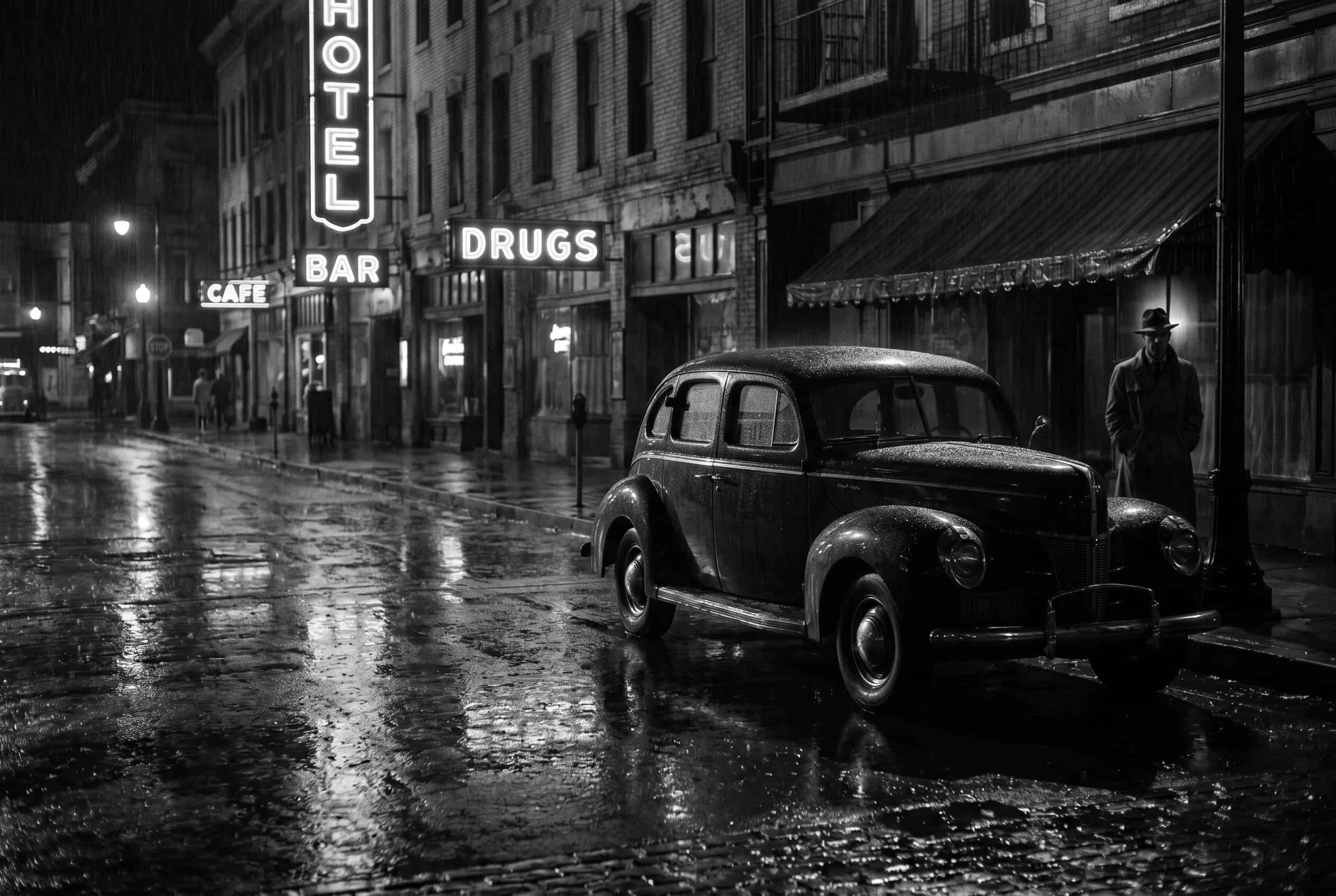
The car arrives before the man does. It rolls into the frame without hurry, its headlights sweeping across a wet curb, its bodywork dark enough to absorb the streetlamp rather than reflect it. The engine is already off by the time the camera settles. The door opens slowly. The man who emerges does not look at the car. He does not need to. The car has already told us everything about him that the next ninety minutes will slowly confirm.
This is how film noir handled automobiles: as instruments of moral atmosphere. The car was never simply transportation. It was a carrier of mood, a signal of intent, a piece of visual language as carefully chosen as the cut of a lapel or the shadow across a venetian blind. Noir directors understood that a car could communicate danger, weariness, class anxiety, or doomed longing before a single line of dialogue was spoken. They trusted the machine to do narrative work, and they trusted the audience to read it.
The internet-era car culture, by contrast, trusts neither the machine nor the audience. It reduces the automobile to a collection of stats, a vehicle for stunts, or a backdrop for a personality. The car is no longer a character. It is a prop. This essay is about what noir knew that we have forgotten, and why recovering that knowledge might change how we see the cars we drive.
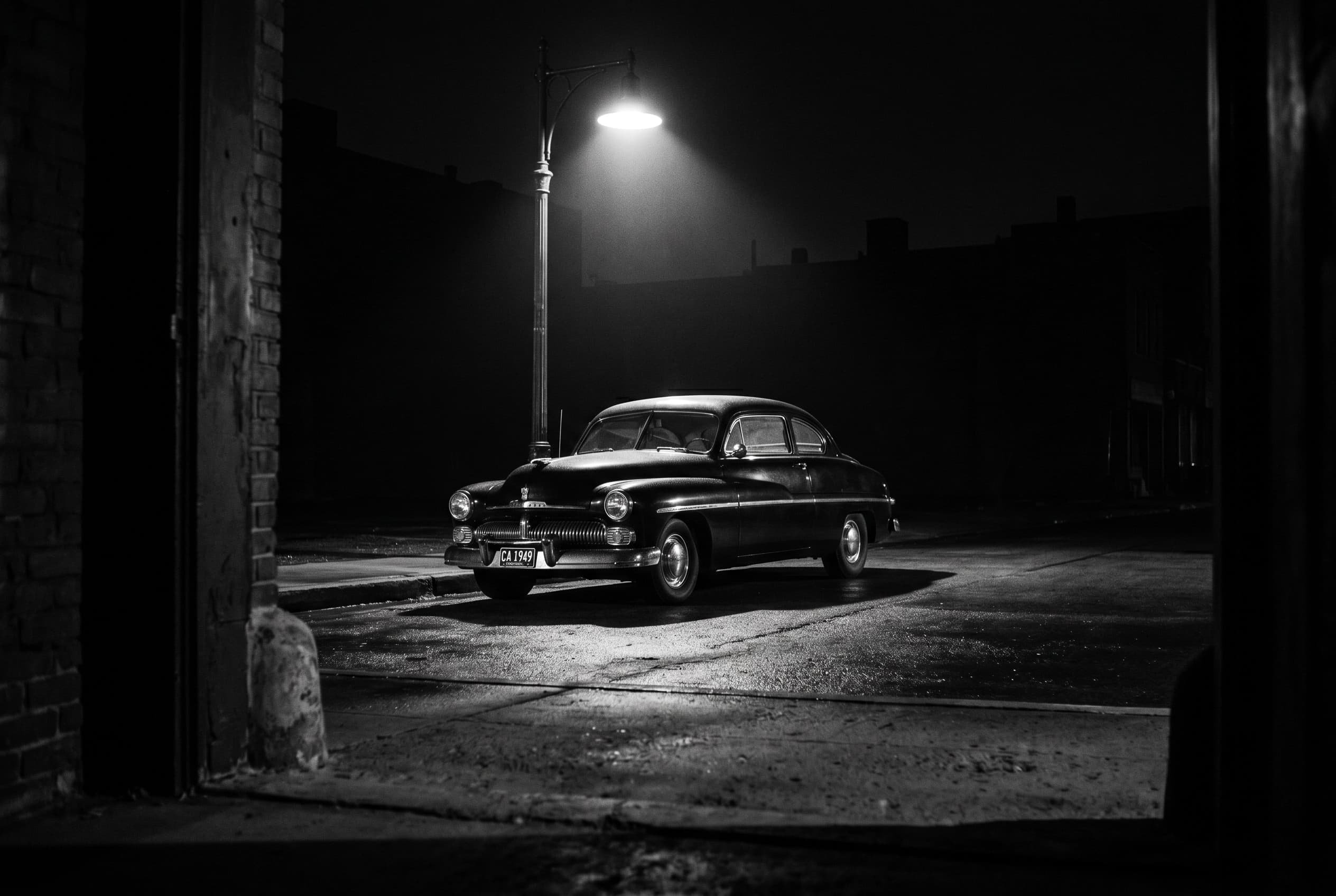
The Car as Moral Weather
The first thing noir understood is that a car carries an ethical charge. It is not neutral. The vehicle a character drives—or is driven in—is a statement about their relationship to power, money, and the law.
The detective's car is tired. It has dents it does not explain. It starts on the second try and idles with a slight miss. It is a machine that has seen enough of the world to stop pretending it is new. When Philip Marlowe slides behind the wheel, the car tells you he is underpaid, overworked, and unlikely to be impressed by anyone's title.
The gangster's car is the opposite. It is large, dark, and immaculately kept. It gleams without being cheerful. It moves through the city like a shark through water—silent, deliberate, and utterly indifferent to the smaller fish. The car does not need to speed. The car is the speed, even when parked. It is violence waiting for a reason.
The woman's car—the femme fatale's car—is something else entirely. It is often a convertible, European, visibly expensive but not in a way that a respectable person would recognize. It is a car that suggests the owner has access to money the source of which no one asks about. When she offers the detective a ride, the car becomes a trap. The passenger door closes with a heavier sound than the driver's door did.
These are not accidents of production design. They are acts of narrative economy. The car tells you who the character is before the character speaks. It is a moral weather system, and noir directors used it the way a novelist uses a first sentence.
Light, Chrome, and the Grammar of Threat
Noir was a genre of light and shadow, and automobiles provided one of its most reliable canvases. The curved fenders of a 1940s sedan caught the streetlamp in a long, liquid streak. The chrome bumper reflected the neon sign across the street, turning the car into a mirror of the city's corruption. The windshield, filmed from outside at night, became a dark surface through which only the faintest suggestion of a face was visible—a driver who could see you but whom you could not see.
This visual grammar had a specific effect: it made the car mysterious. Not mysterious in the sense of being unexplained, but mysterious in the sense of containing something that was not immediately visible. A noir automobile was a volume of shadow that happened to move. It carried secrets the way it carried passengers, and you were never quite sure what would emerge when the door opened.
Modern car content has eliminated this mystery entirely. The car is presented in flat, even light, every angle photographed, every specification listed, every surface polished to a glare. There is nothing hidden. There is nothing left for the viewer to discover. The car is explained before you have even seen it, and explanation is the enemy of atmosphere.
Table: Noir's Automotive Language vs. The Internet's Car Content
Element | Film Noir | Internet Car Content |
|---|---|---|
Lighting | Shadowed, directional, chiaroscuro; the car emerges from darkness | Flat, even, ring-lit; the car is fully exposed |
Framing | Low angles, distant shots, the car as part of a larger composition | Close-up, centered, the car as the only subject |
Movement | Slow, deliberate; arrival and departure carry dramatic weight | Fast cuts, acceleration shots, the car as spectacle |
Sound | Engine as murmur, door as punctuation, silence as tension | Engine as soundtrack, exhaust as content, silence avoided |
Relationship to character | The car reveals the person; it is an extension of moral identity | The car is a prop for the personality; the person reveals the car |
Audience position | Observer, interpreter; the audience must read the car | Consumer, viewer; the audience is told what to think about the car |
Treatment of time | The car ages, accumulates history, carries wear | The car is new, detailed, prepared for sale |
The difference between these two columns is not technological. It is philosophical. Noir treated the automobile as a subject worthy of interpretation. The internet treats it as an object to be consumed. The first approach deepens the car. The second flattens it.
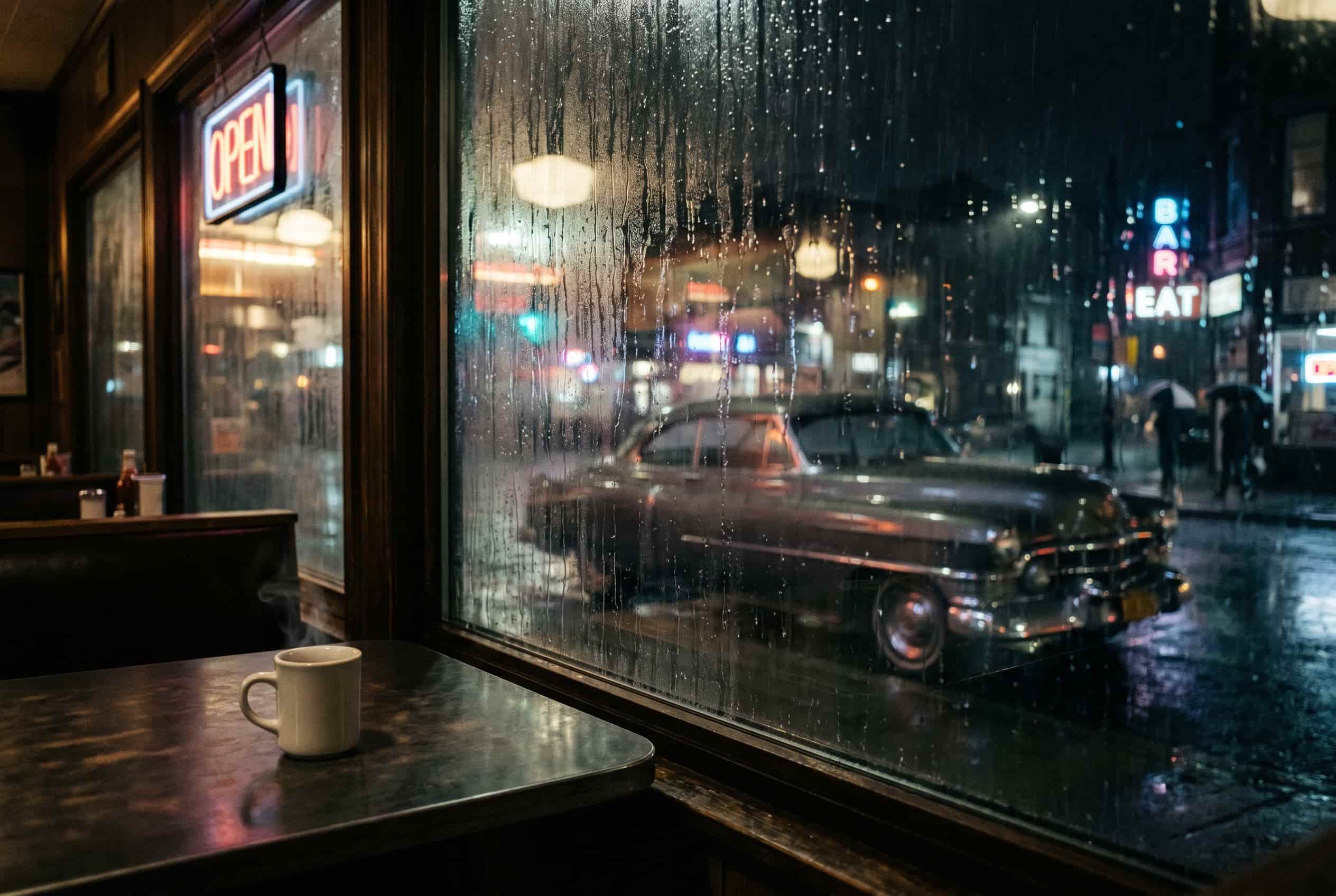
The Automobile as Unspoken Dialogue
One of noir's quietest innovations was the use of the car interior as a stage for intimacy and threat. Two people in a car at night, streetlights sliding across the dashboard in regular pulses, the city reduced to a blur beyond the glass. The car is moving, which means neither person can leave. The conversation that takes place in this sealed, moving room is different from any conversation that could happen elsewhere. It is more honest, or more dangerous, or both.
The dashboard instruments glow faintly, just enough to illuminate the lower half of a face. The rearview mirror frames a pair of eyes. The steering wheel is a barrier and a support—something to lean on, something to grip. When the driver says something he should not have said, the camera holds on his hands tightening on the wheel, and that single gesture carries the weight of a confession.
This use of the car interior as a psychological space has no equivalent in modern automotive media. Car reviews do not film the reviewer in the passenger seat, being driven somewhere against their will, realizing that the driver is not who they claimed to be. YouTube does not capture the silence between two people in a sedan at a red light, the engine ticking over, the decision hanging in the air. These are dramatic uses of the automobile that reveal what the car actually is: a room in which human beings are trapped together, or freed together, depending on who is driving.
What We Lost When Cars Became Content
The noir automobile was never the star of the film. It was a supporting actor, and like all good supporting actors, it improved the scenes it was in without drawing attention to itself. It understood its role. It served the story.
The modern car video reverses this hierarchy. The car is the star, the personality is the host, and the story is an afterthought. The car is driven fast because fast looks good in a thumbnail. The car is filmed from a drone because drones are available. The exhaust note is captured in high fidelity because the exhaust note generates engagement. None of this is storytelling. It is content production, and it treats the car as a raw material rather than a finished narrative object.
The loss is not merely aesthetic. It is a loss of meaning. When a car is presented only as a collection of specifications and sensations, it ceases to signify anything beyond itself. It is fast, or it is loud, or it is expensive. But it does not mean anything. It does not carry an ethical charge. It does not place a character in a moral landscape. It does not make you wonder what will happen when the door opens. It is exactly what it appears to be, and nothing more.
Noir understood that the most powerful objects are the ones that suggest more than they reveal. The car parked in the shadows, the car pulling away from the curb without headlights, the car that arrives too late and leaves too soon—these images endure because they refuse to explain themselves. They trust the viewer to lean in, to interpret, to feel. That trust is the deepest form of respect an image can offer. And it is precisely what the algorithm cannot replicate.
A Way Forward
I am not suggesting that car culture should start filming itself in black and white or hiring screenwriters. What I am suggesting is that the way we look at cars has become impoverished, and that noir offers a corrective.
Look at a car the way a noir cinematographer would: in shadow, in context, in relationship to a human figure. Notice what the car says before anyone speaks. Pay attention to the sound of the door closing, the weight of the gear lever, the way the cabin feels when the city is dark and the passenger is silent. These are not nostalgic exercises. They are ways of recovering the automobile as a vessel of meaning rather than a container of features.
The best cars do not demand attention. Neither did the best noir automobiles. They simply waited in the dark, chrome catching the light of a distant sign, until someone looked long enough to wonder what they were doing there. That is the relationship between car and observer that this blog exists to protect.