
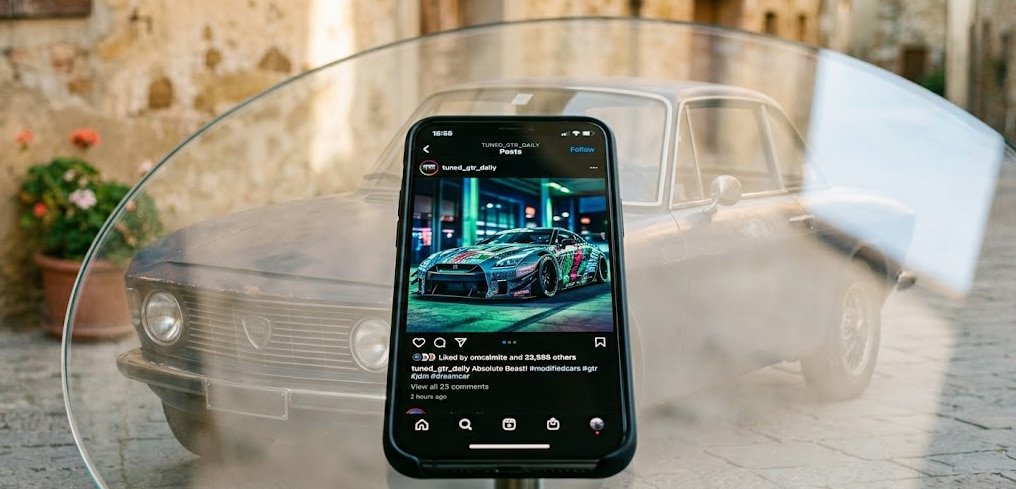
There was a time, not long ago, when a man could want a car for reasons he could not fully explain. He might have seen one in a film, or passed one on a wet street at dusk, or found a photograph in a magazine that he tore out and kept in a drawer. The want was private, specific, and slightly irrational. It had no engagement metrics. It asked nothing of anyone else. It was simply there—a quiet, persistent pull toward a machine that had lodged itself in his imagination and refused to leave.
That kind of desire is now endangered. It has been replaced by a new kind of wanting: the kind that is formed by an algorithm, validated by a like count, and structured by a content calendar. Social media did not amplify automotive desire. It flattened it. It took the strange, private, ungovernable experience of wanting a car and pressed it into a template. This essay is about what was lost in that compression—and why the flattening matters.
The Algorithm's Definition of Desire
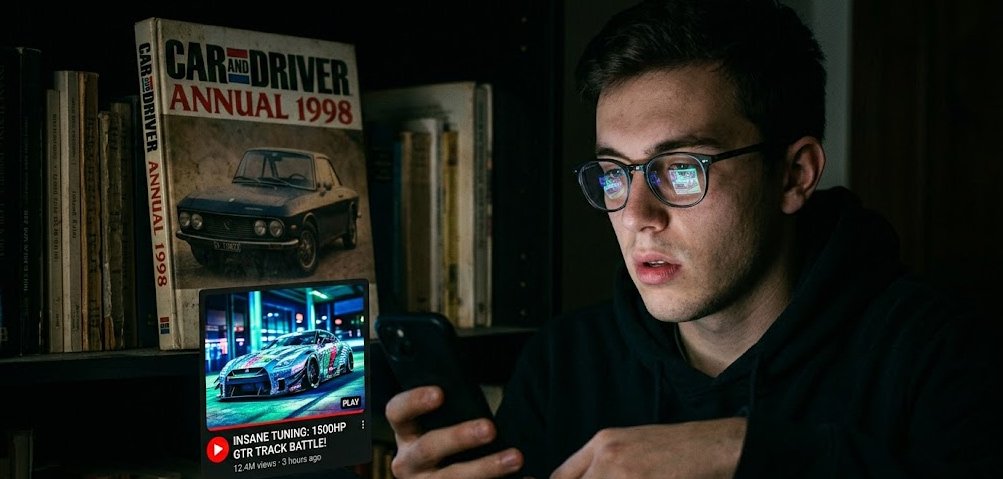
The social media algorithm has a single task: to keep you on the platform. Everything it shows you—every car, every clip, every exhaust-note compilation—is selected because it is likely to produce engagement. Engagement means a like, a share, a comment, or simply a few more seconds of viewing time. The algorithm is not interested in whether you form a deep, lasting connection with a machine. It is interested in whether you will watch the next video.
This incentive structure has reshaped what kinds of cars become visible, and how they are presented. The cars that thrive on social media are the ones that read well in a three-second scroll. Extreme modifications. Loud exhausts. Drastic color schemes. Hypercars that almost no one will ever drive. The car that rewards patient study—the subtle proportion, the honest material, the design that reveals itself over years—has no mechanism to go viral. It is not built for the format.
The format also reshapes the nature of wanting itself. On social media, desire is not something you cultivate. It is something you receive, ready-made, pre-packaged, and pre-validated by a crowd. You do not stumble upon a car in a forgotten photograph and feel an inexplicable pull. You are shown a car that a million other people have already been shown, and you are told that this is what you should want. The wanting is social before it is personal. It arrives with a like count attached.
The Shrinking of the Imaginable
The most damaging effect of social media on automotive desire is not that it shows us bad cars. It is that it narrows the range of cars we are able to imagine wanting.
Before the algorithm, a man's automotive imagination was fed by a wide and unpredictable range of sources. A magazine article. A neighbor's car. A trip abroad. A black-and-white film. A brochure found in a secondhand bookshop. The inputs were random, and the randomness was productive. It meant that a man could develop an attachment to a car that was not on anyone else's radar—a Fiat 130 coupe, a Peugeot 504 convertible, a Rover P6 with a vinyl roof. The desire was unshared, and in being unshared it was intensely personal.
The algorithm replaces randomness with optimization. It shows you what it knows you will engage with, based on what you have engaged with before. If you watched a video of a modified BMW, you will be shown more modified BMWs. If you liked a photograph of a supercar, you will be shown more supercars. The field narrows with every interaction. The algorithm does not introduce you to the Fiat 130 coupe. It does not know the Fiat 130 coupe exists, because the Fiat 130 coupe does not have enough content to generate an engagement profile. The car is invisible to the algorithm, and therefore invisible to you.
This narrowing is not a conspiracy. It is an emergent property of the system. But the result is a generation of car enthusiasts whose desires are remarkably uniform. The same ten cars, the same five modifications, the same three color schemes, cycling endlessly through the feed. The desire has been flattened into a template, and the template leaves out most of what makes the automobile interesting.
The Performance of Wanting
There is another flattening at work, and it has to do with performance. On social media, wanting a car is no longer a private state. It is a public act. You declare your desire by posting, liking, commenting, and sharing. The desire exists in the feed, not in the mind. It is performed for an audience, and the performance changes the desire itself.
A man who performs his desire for a car on social media is no longer wanting the car. He is wanting the validation that comes from being seen to want the car. The car becomes a prop in a personal brand. The actual experience of the machine—how it drives, how it feels at speed, how its cabin settles around you on a long night drive—is secondary. What matters is the image of the car, and the image of the man who claims to want it.
This is a radical inversion of what automotive desire has been for most of the automobile's history. Wanting a car was once a private affair. A man could nurse a longing for a specific machine for years, telling almost no one, and the privacy of the longing was part of its richness. The car existed in his imagination as a pure object of desire, untainted by anyone else's opinion. That kind of desire is now almost impossible to sustain, because the platforms have made every desire visible, comparable, and rankable. You cannot want a car in private because the algorithm will not let you.

The Loss of the Unshareable
What is lost when desire becomes public and algorithmic is not merely variety. It is the unshareable dimension of wanting—the part of desire that is so specific, so personal, and so irrational that it cannot be translated into a post.
Every man who truly loves cars has at least one machine that he cannot fully explain. It is not the fastest car. It is not the most beautiful. It is not the one that would impress anyone at a gathering. But it has lodged itself in him, and he cannot get it out. Maybe it was the first car he drove. Maybe it was the car his grandfather owned. Maybe it was a car he saw once, for ten seconds, on a trip he took twenty years ago, and the image has never faded. The desire is inexplicable. It cannot be justified. It cannot be shared. And that is precisely its value.
Social media has no room for the inexplicable. The inexplicable does not generate engagement. It does not fit into a listicle or a comparison video. It cannot be photographed in a way that communicates its hold on you. The algorithm ignores it, and over time, the enthusiast who lives on social media learns to ignore it too. His desires become the desires that the platform can accommodate. The unshareable atrophies.
The blog you are reading exists in part to resist this atrophying. It exists to make room for the unshareable—for the strange, specific, private attachments that form between a person and a machine, for reasons that no algorithm could ever predict and no engagement metric could ever measure.
The Way Out
I am not suggesting that car enthusiasts should delete their accounts and retreat into silence. I am suggesting that the relationship between a person and the car they want should be formed, at least in part, away from the feed.
Read old magazines. Look at printed brochures. Go to a concours and walk past the prize winners to the cars in the back row, the ones that no one is photographing. Watch a film from the 1960s and notice the car in the background, the one that is not the star but is somehow more interesting than the star. Drive without a destination, and notice what you notice. Let the wanting arise from the encounter, not from the algorithm.
The desire for a car should be like the car itself: something that rewards long attention, that deepens over time, that resists being summarized in a caption or compressed into a reel. The best cars do not demand attention. Neither should the best wanting. It should be quiet, stubborn, and entirely one's own.