
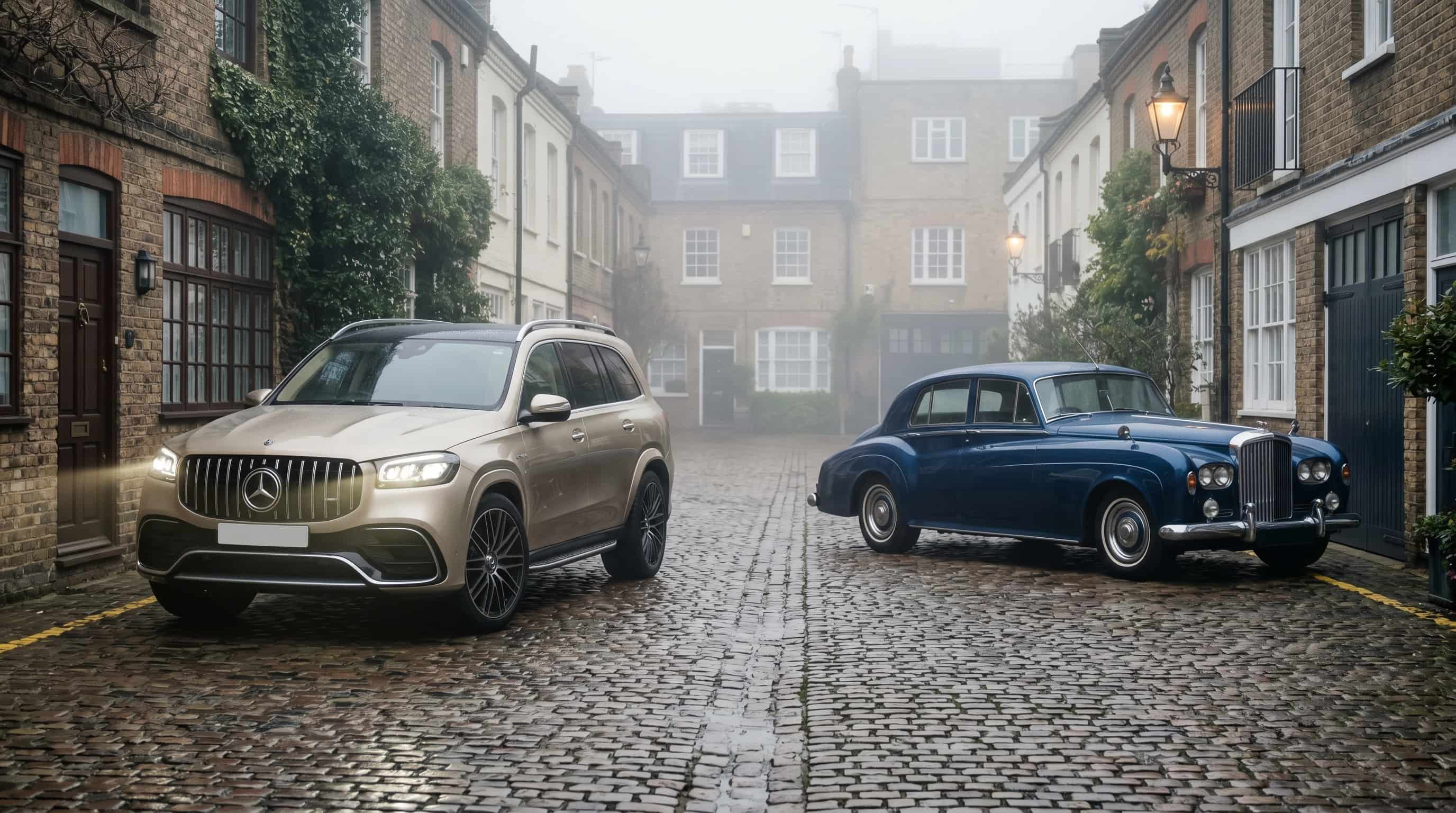
The words are often used as if they are synonyms. They are not. Luxury is a condition of supply and demand. Taste is a condition of judgment. Confuse them, and you will find yourself in a showroom full of vehicles that cost more than a house and look like they were styled by a committee that had never read a book.
I have spent enough time around cars to know that the most expensive vehicle in any given room is rarely the most distinguished. The distinction belongs to the machine that was chosen, not merely acquired. It belongs to the car that someone looked at and said, "This, not that," with a reason that went deeper than price or performance figures. This essay is an attempt to give that distinction its proper name, and to argue that taste—unlike luxury—is something you must earn.
The Definitions
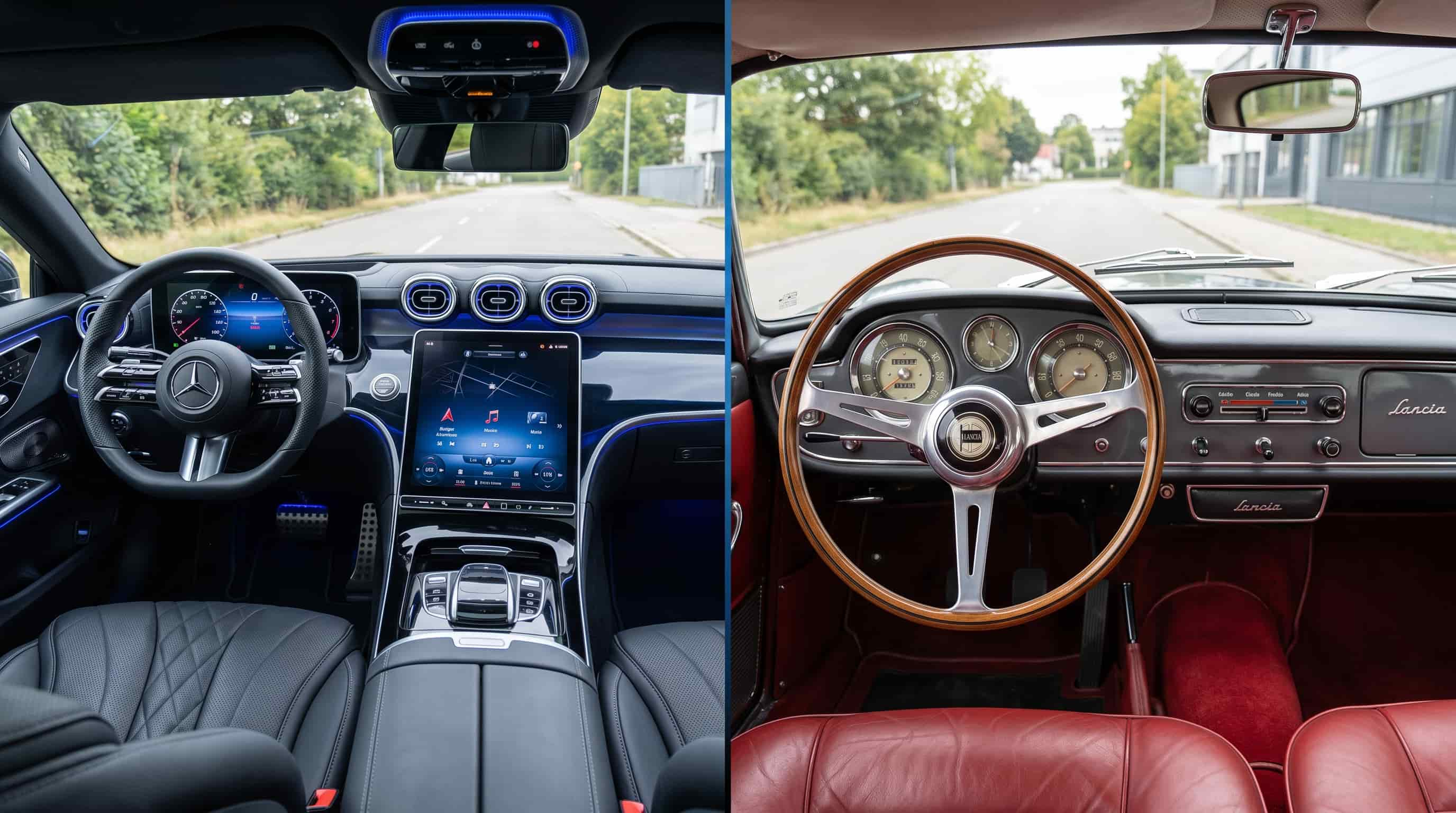
Luxury is the presence of more. More power, more technology, more leather, more screen acreage, more noise-cancellation, more ambient light colors, more logos. It is quantitative. It can be measured, compared, optioned, and invoiced. A car is luxurious because its manufacturer has included things that its competitors omitted, and because those things are expensive to produce or purchase. Luxury, in this sense, is a transaction.
Taste is the presence of what is necessary, and the confident absence of everything else. It is qualitative. It cannot be optioned or invoiced. A car has taste because its creators made judgments about what to leave out, and those judgments were correct. Correctness in this context is not subjective. It is a matter of proportion, material honesty, and a refusal to do violence to the eye. A car with taste does not ask for your approval. It assumes that if you have the equipment to recognize it, you will.
The confusion between these two categories is the engine of a great deal of automotive ugliness. A buyer walks into a showroom with a budget and a desire to be impressive. The salesperson translates the budget into options, and the desire into a vehicle that shouts. The buyer leaves believing he has purchased taste. He has purchased luxury. The difference will become visible the first time the car is parked next to a machine that has the real thing.
What Luxury Reveals
Luxury, left to its own devices, tends toward excess. The oversized grille is a luxury impulse. It says: we can make this larger, so we will. The illuminated emblem is a luxury impulse. It says: we have LEDs, so we must use them. The cabin filled with screens is a luxury impulse. It says: we can display more information, so we must, regardless of whether the driver needs it or wants it.
This is not a critique of luxury. Luxury has its place. A heated steering wheel on a February morning in Boston is luxury, and I am grateful for it. Active safety systems that prevent collisions are luxury, and they save lives. The problem arises when luxury is mistaken for a complete aesthetic position. It is not. It is a set of materials and capabilities. What those materials and capabilities are used to build is a separate question.
A car that possesses luxury but not taste is a car that has everything and says nothing. It is a collection of expensive parts that have not been composed. It impresses on first glance and exhausts on third. It is the automotive equivalent of a man who walks into a room wearing every indication of his net worth and not a single indication of his personality.
What Taste Demands
If luxury is about having, taste is about choosing. And choosing requires criteria. The person who chooses a car with taste has asked questions that the person who simply purchases a luxury vehicle has not.
Does the shape reward long looking, or does it lose interest once the novelty fades? Are the materials what they appear to be, or will they embarrass themselves in five years? Does the cabin quiet the mind or fill it with ambient noise and glow? Is the car coherent—does every line and surface belong to the same idea—or does it look like three different design teams worked on three different sections and never spoke?
These questions cannot be answered by a configurator. They require a trained eye, and the eye is trained by looking. At cars, at buildings, at paintings, at the way a jacket falls from a shoulder. Taste is the accumulation of all these acts of attention, applied to the act of selection.
Table: Luxury vs. Taste in Automobiles
Dimension | Luxury | Taste |
|---|---|---|
Primary drive | Abundance, inclusion, novelty | Judgment, exclusion, endurance |
Relationship to money | Requires expenditure | Requires cultivation; cost is incidental |
Visual signature | Large grilles, illuminated badges, multiple screens, pronounced ornament | Proportion, restraint, material honesty, negative space |
Cabin atmosphere | Ambient light shows, configurable displays, haptic surfaces | Warm instrument glow, analog tactility, shadow and silence |
Relationship to time | Dates quickly; next year's model makes this year's feel obsolete | Ages into itself; acquires patina, deepens in character |
Signal to others | "I can afford this" | "I understood why this was worth keeping" |
Typical examples | Overspecified modern luxury SUVs, performance sedans with optional carbon trim packages | Lancia Flaminia coupe, Mercedes W111 280SE, Jaguar XJ6 Series 1, Alfa Romeo Giulia Sprint GT |
The examples in the bottom row are instructive. Several of the cars in the taste column were expensive when new. But their current value to the observer does not come from their cost. It comes from their coherence. They were designed by people who understood what to leave off, and that understanding is now visible in every line.
The Tasteful Car Does Not Declare Itself
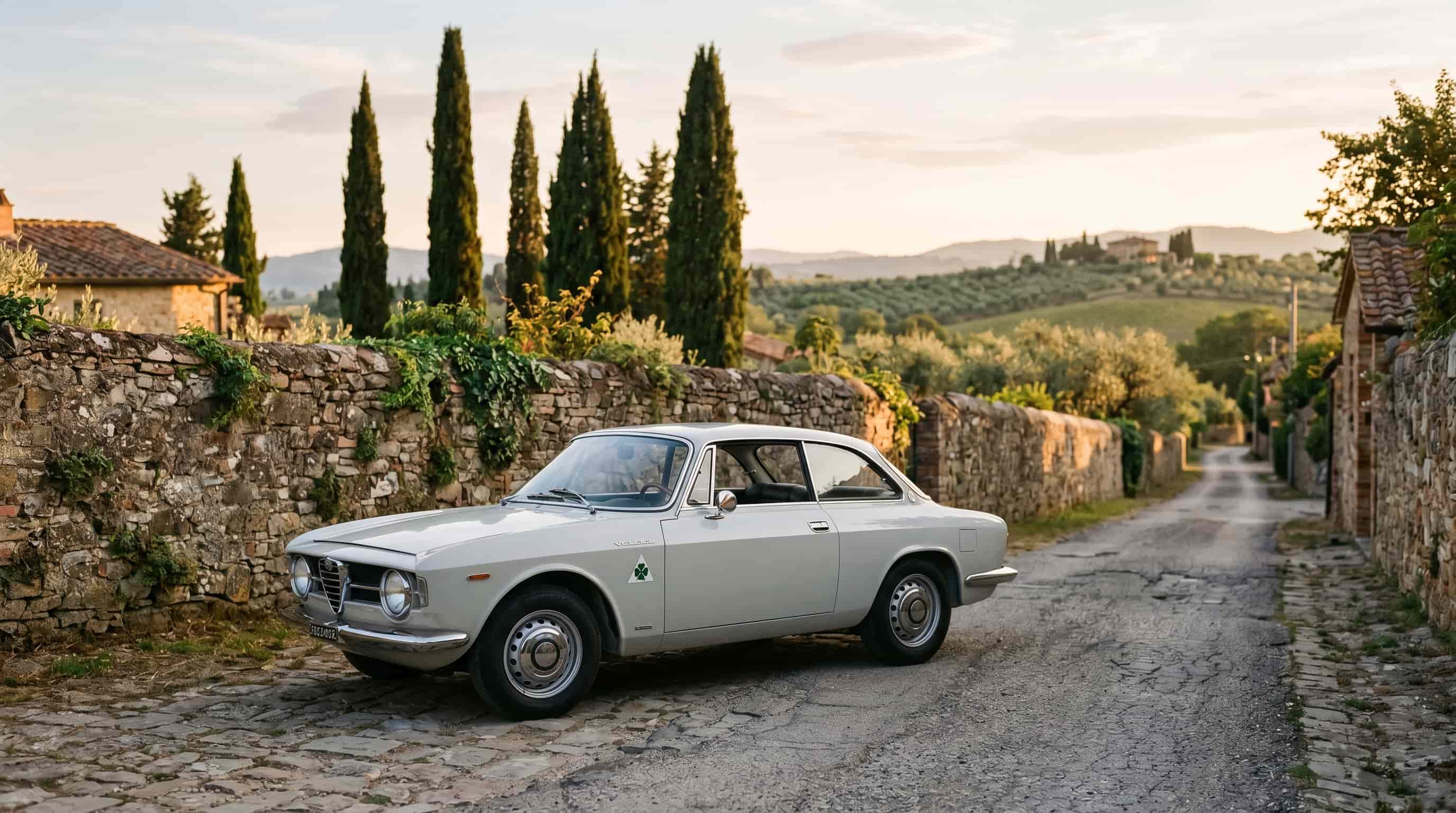
One of the clearest markers of an automobile with taste is that it does not feel the need to announce its own quality. The Giulia Sprint GT does not have a badge that tells you it is a design classic. The Lancia Flaminia does not wear its Pininfarina origins on its grille. The Mercedes W111 does not explain to you that its chrome was applied by hand. These cars assume that if you are the kind of person who would appreciate them, you will recognize them without being told. If you are not, they are not going to lower themselves by explaining.
This absence of self-congratulation is a hallmark of taste in any domain. A well-designed room does not have a sign telling you who the architect was. A well-prepared meal does not arrive with a paragraph of description. A well-dressed man does not wear a label on his sleeve. The thing speaks for itself, or it does not. If it does not, no amount of explanation will save it.
The luxury vehicle that lacks taste tends toward the opposite. Its grille is designed to be recognized at a distance. Its ambient lighting is designed to be seen through the window at night. Its exhaust note is designed to be heard before the car is visible. These are the gestures of a machine that is afraid you will not look, and that fear is the final proof that the car does not trust its own value.
How Taste Is Acquired
If taste is a discipline, it follows that it can be learned. It is not an aristocratic inheritance, though it can be inherited. It is not a function of education, though it can be taught. It is a function of attention, repeated over time, applied to objects that repay the effort.
The person who wishes to develop automotive taste should do several things that no algorithm will recommend. Spend time with old brochures, the ones printed on heavy paper with serif typefaces and no exclamation points. Look at the way the cars were photographed—the angles, the light, the backgrounds that were chosen to suggest a life rather than a lap time. Visit a concours not to see which car wins but to walk the field and notice which cars hold your eye after the tenth viewing. Read design criticism from outside the automotive world—architecture, furniture, typography—and bring those standards back to the showroom. And above all, look at the cars themselves, in person, with the engine off and the screens dark, for as long as they will let you.
This process is slow. It cannot be accelerated by money. But it is the only reliable path to the kind of judgment that distinguishes a luxurious car from a tasteful one.
A Distinction Worth Preserving
I am not against luxury. I am against the confusion of luxury with taste, because that confusion lets bad design escape criticism and lets good design go unrecognized. The two categories overlap less often than the market would have you believe. Some of the most luxurious vehicles ever built—certain Rolls-Royces of the 1980s, certain full-option Mercedes of the 1990s—are almost entirely devoid of taste. And some of the most tasteful vehicles ever built—a base-model Saab 99, a Volvo 240, an early Honda S800—were never luxurious at all.
The blog you are reading exists in part to maintain this distinction. When I praise a car, I am not praising its price. When I criticize a design, I am not criticizing its market position. I am applying a standard that luxury does not own and cannot buy.
The best cars do not demand attention. The same can be said of the best taste. It does not announce itself. It does not insist. It simply waits, in a W111 coupe, in a Giulia Sprint GT, in a Flaminia on a quiet lane, for someone to notice that it is there.