
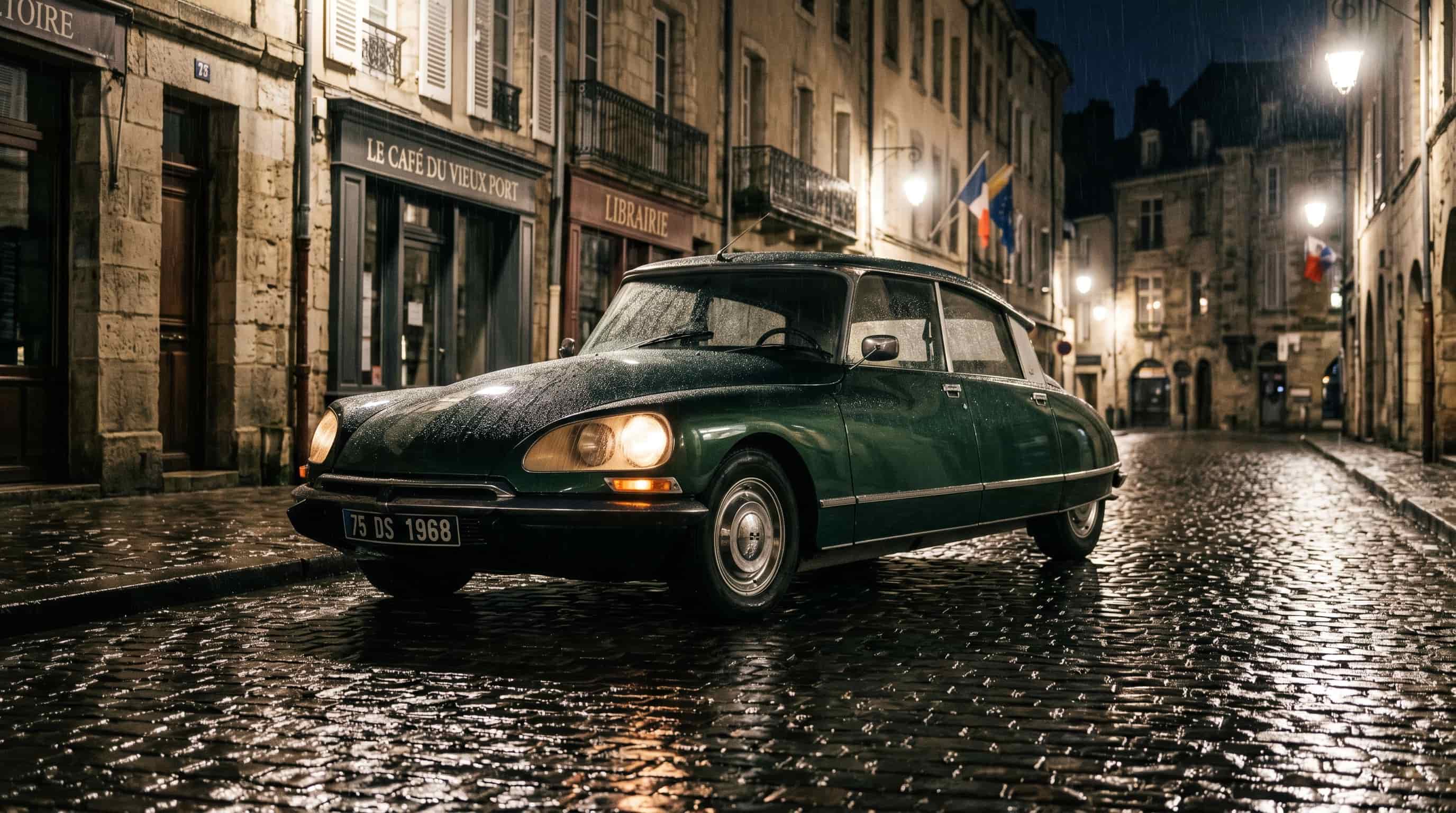
There are cars that photograph best under a hard blue sky, their paint metallic and their chrome glinting. They are cars for the brochure shot, the concours lawn, the Sunday morning drive with the windows down and the sun on your arm. I understand these cars. I have driven them and written about them. But they are not the cars I think about when rain begins to streak the window of my study and the forecast says the front will not clear until Tuesday.
The cars I think about in those moments are different. They are the cars that seem to have been designed in a climate where rain was not an interruption but a condition. They are the cars whose shapes resolve in diffuse light, whose cabins feel more substantial when the world outside is wet, whose controls and materials and outward visibility make sense only when the sky is the color of pewter and the road is a dark ribbon of standing water.
These are the cars that belong in rain. This essay is about them—and about why certain machines make more sense when the weather turns.
The Saab 900 and the Cathedral of Bad Weather
I will begin with the Saab 900 because no conversation about rain and automobiles can begin anywhere else. The Saab 900 was designed in Sweden, a country that has no illusions about the weather, by engineers who understood that a car should make rain feel like an invitation rather than an assault.
The 900's relationship to bad weather was built into its architecture. The windshield was closer to the driver than in almost any other car, pulled forward by the cab-forward design. The pillars were thin by any standard, and absurdly thin by modern ones. The glass area was vast and nearly vertical, like a small observational turret. The result, in rain, was a kind of clarity that modern cars have entirely abandoned. The water hit the glass and was swept away. The view remained expansive. The driver felt not sealed off from the storm but comfortably stationed within it, like a lighthouse keeper watching weather through thick, well-made panes.
The 900 also had another rain-specific virtue: the ignition between the seats. This sounds unrelated. It is not. In a downpour, you did not have to stand beside the car fumbling at the steering column. You opened the door, sat down, closed the door behind you, and started the car from inside your own personal dry space. The sequence was swift, dignified, and dry. Saab understood that a car's relationship to weather begins before the engine starts, at the moment of entry. That moment, in a 900, was protected.
Citroën and the Art of the Wet Road
If Saab mastered the cabin's relationship to rain, Citroën mastered the chassis's. The hydropneumatic suspension that defined the DS, the GS, and the CX was not merely a comfort feature. It was a rain feature. It produced a ride that was indifferent to the surface beneath it, and that indifference became most valuable when the surface was at its worst.
A Citroën DS on a wet road is a lesson in composure. The suspension absorbs standing water, broken pavement, and the occasional submerged pothole with a detachment that borders on disdain. The steering is light, the body roll pronounced but predictable, and the overall sensation is of a car that has made a separate peace with the laws of physics. You can drive a DS through a storm at a pace that would be reckless in anything else and feel not merely safe but serene. The car is not fighting the conditions. It is accepting them, and moving through them, and the difference between fighting and accepting is the entire art of wet-weather driving.
The DS also had a rain-specific design feature that no modern car would attempt: the single-spoke steering wheel. It looked like a question mark. It was thin, unadorned, and positioned so that the driver's hands could rest at the bottom of the rim while the top of the wheel remained perfectly visible. In rain, this meant the instrument panel was never obscured. The driver could monitor speed and warnings without moving a hand or shifting a glance. The wheel was an act of visual transparency. It trusted the driver to see, and it gave them the tools to do so.
The Defender, the G-Wagen, and the Worthiness of Getting Wet
There is another category of rain cars, and it is not elegant. It is the category of the machine that does not keep the rain out so much as endure it alongside you.
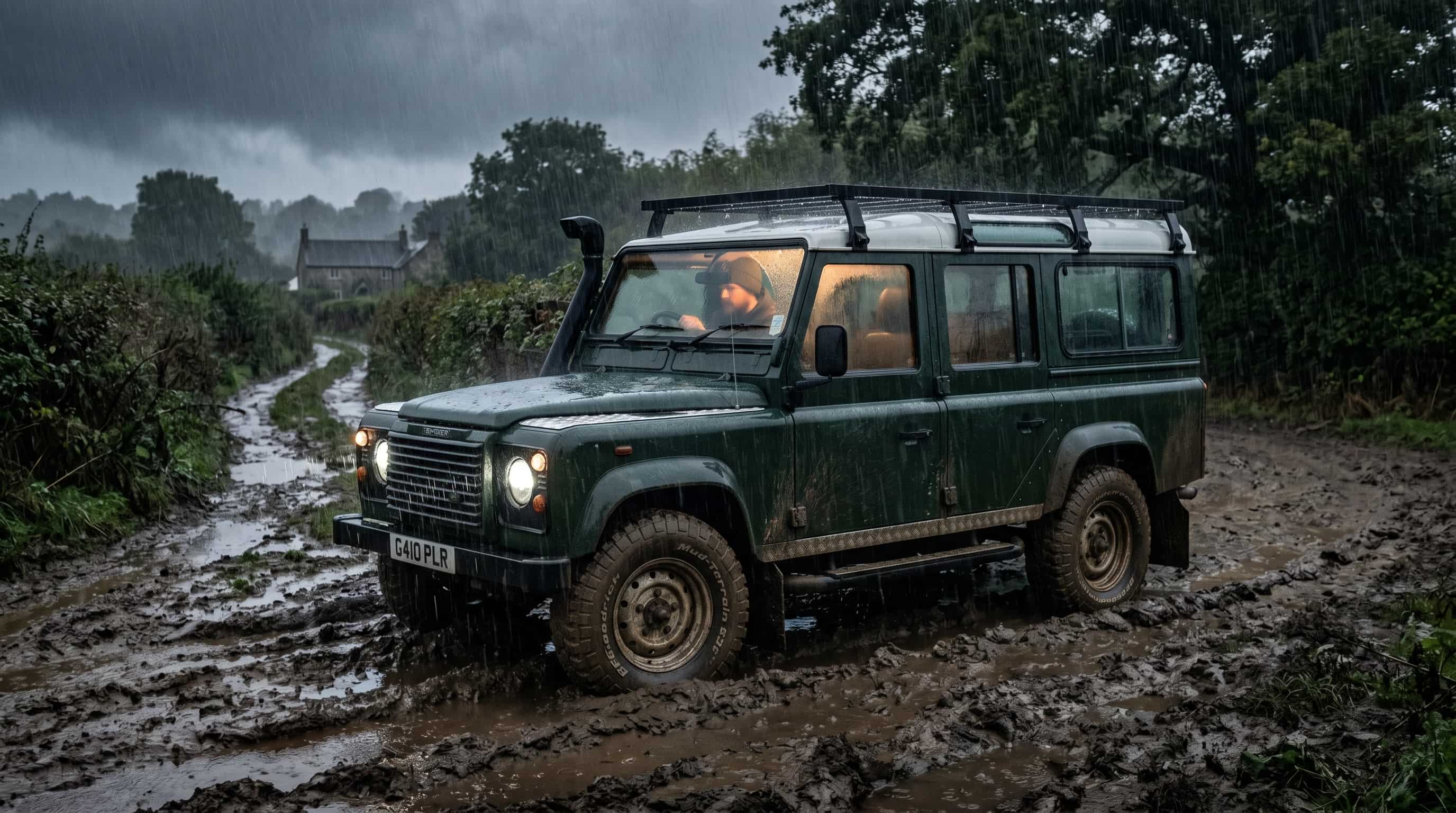
The old Land Rover Defender did not have a cabin that stayed dry in a heavy storm. The door seals leaked. The roof seams wept. The heater was an asthmatic suggestion. Driving a Defender in prolonged rain was an exercise in shared suffering. You got wet. The car got wet. You arrived at your destination damp in specific places and dry in others, and the car sat outside the pub or the farm gate with water pooling in the footwells, and neither of you complained.
There is, I think, a kind of honesty in this. The modern luxury SUV seals its occupants in a climate-controlled bubble, the rain reduced to a silent video playing beyond the double-glazed glass. The experience is comfortable but disconnected. The Defender offered the opposite: full sensory participation in the weather, with the understanding that you and the machine were in it together. You were not above the storm. You were in the storm, and the car was your companion in the wet, and that companionship was worth more than a dry left knee.
The Mercedes G-Wagen of the same era offered a similar pact, though executed with rather more Germanic seriousness. The door handles were milled metal, the locks were mechanical, the drain plugs in the floor were included not as an afterthought but as a design brief. You could hose out a G-Wagen. You could ford a river in one, and the water that came in through the door gaps would exit through the drains, and the car would not care. This indifference to wetness is a form of character. It says: I was built for conditions that would ruin lesser machines. Rain is not an emergency. Rain is Tuesday.
The Windshield as Canvas
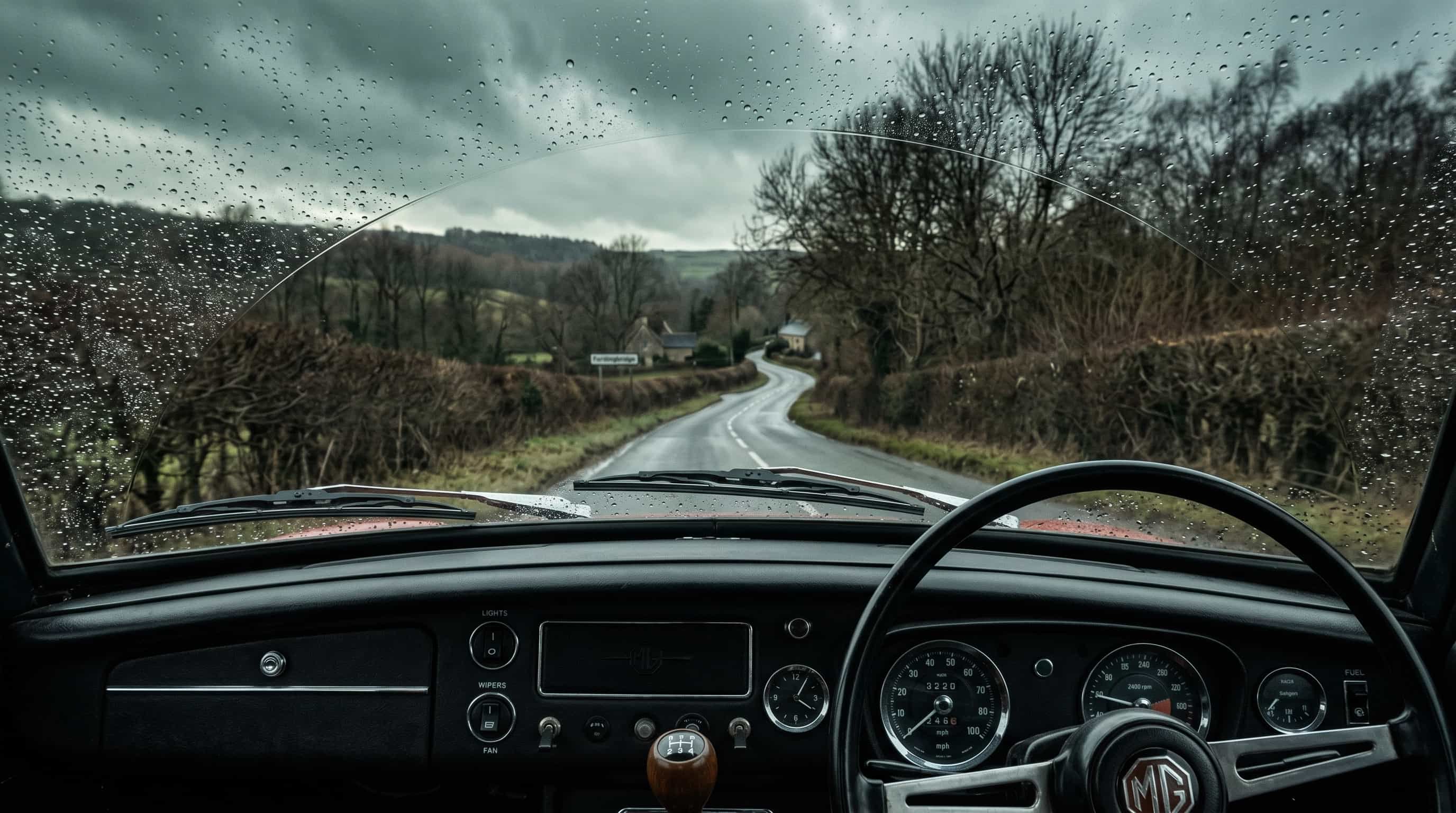
There is a pleasure in rain driving that has nothing to do with the car's mechanical virtues. It is the pleasure of the windshield as a moving painting. The water beads, streaks, and reforms. The wipers clear an arc that is immediately re-occupied. The lights of other vehicles smear into long, diffuse ribbons of red and white. The world beyond the glass is softened, abstracted, made slightly unreal.
Certain cars amplify this effect. The upright windshield of a Volvo 240, the deep dash of an old Mercedes W123, the close-set glass of a Saab 900—these geometries create a particular relationship between the driver's eye and the water. The glass is near enough that the rain reads as texture rather than obstruction. The pillars are thin enough that the view remains panoramic even when the wipers are working hard. The cabin is quiet enough that you can hear the rain on the roof, a steady percussion that is one of the most calming sounds a machine can host.
The modern car often ruins this. The windshield is raked so steeply that water sheets rather than beads, creating a continuous blur. The pillars are thick enough to hide a motorcycle. The cabin is so aggressively insulated that the rain becomes a silent film, and the silence removes the very thing that made the experience atmospheric. The rain becomes an inconvenience rather than an accompaniment. The car treats it as something to be eliminated rather than something to be inhabited.
The Car That Waits for Weather
I have a friend in Vermont who owns a Citroën DS that he drives only in rain. This is not a maintenance decision or a mechanical limitation. It is an aesthetic one. He believes, and I have come to agree with him, that the DS does not make visual sense under a blue sky. The shape is too organic, too aquatic. It needs the diffuse light of an overcast afternoon to resolve properly. The reflections on the bodywork need to be soft and elongated, not sharp and specular. The suspension needs the additional purpose of absorbing a wet, broken road.
He is not wrong. The car looks uncomfortable in photographs taken on bright days, the way certain people look uncomfortable in formal wear. It is not its element. Put the same car on a wet road in November, with the leaves turning to mush on the verge and the sky a uniform gray, and suddenly the shape makes sense. The car and the weather are speaking the same language.
There are more cars like this than most people realize. The original Fiat 500 looks absurd in sunshine and perfect in the narrow, rain-darkened streets of an Italian hill town. The Jaguar XJ6 makes more sense on a wet B-road in Lancashire than it ever will on a California highway. The Volvo 240 was visibly designed for the half-light of a Scandinavian autumn, and when you see one in Florida you are looking at a car that has been removed from its native climate like a polar bear in a zoo.
These cars belong in rain. They were conceived in countries where rain is not an exception but a rhythm, and their shapes carry that heritage in every curve and shutline.
A Quiet Drive in the Wet
I took a drive last spring in a borrowed Saab 900 Turbo, on a day when the forecast had promised clearing skies and delivered the opposite. The rain began as I left the city and intensified as I reached the two-lane roads that wind through the hills west of here. The wipers were on their fastest setting. The defroster was working hard. The cabin smelled of warm wool and damp carpet and that particular Saab smell, the one that is equal parts engineering and modesty.
The car did not care about the rain. It tracked straight through standing water that would have unsettled a modern car with wider tires. The turbo spooled softly in third gear, the boost gauge flickering in the corner of my vision. The view through the windshield was clear, uncluttered, the pillars so thin they almost disappeared. I drove for two hours and arrived home calmer than I had left.
That drive is the reason I am writing this essay. The cars that belong in rain are the cars that make bad weather feel like good fortune. They do not fight the conditions. They accept them. And in accepting them, they remind you that the right machine, in the right weather, can turn a forecast into an invitation.