
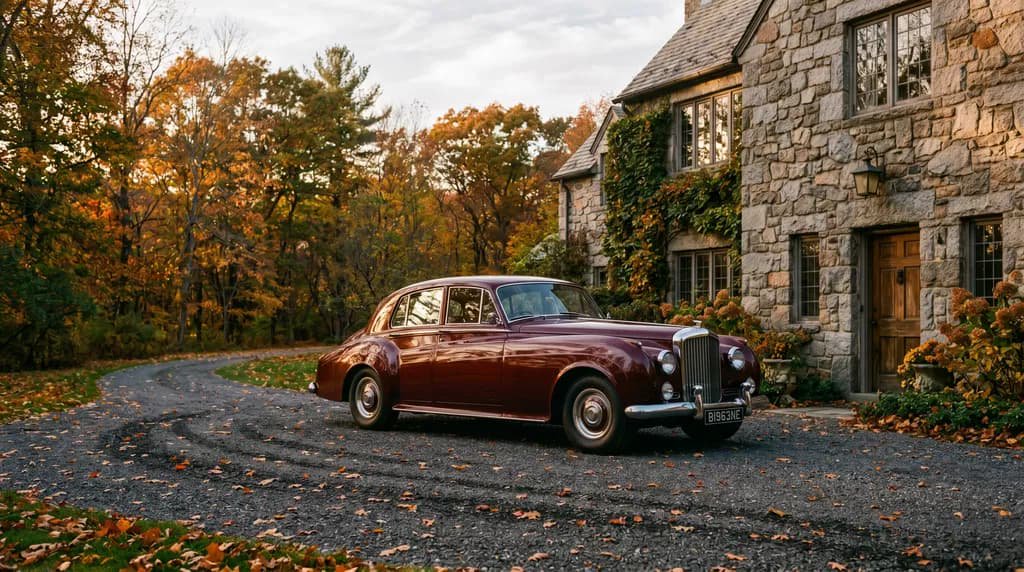
There was a time, not as long ago as it feels, when the most expensive car on a street was often the quietest one. It did not arrive with a bark. It did not wear its price tag on its grille. It did not fill its cabin with ambient light shows or wrap its exhaust note in synthesized fury. It simply appeared, settled into its wheelbase, and let its presence do the work.
That version of prestige has become nearly illegible to the modern market. Today, luxury automobiles compete on the decibel level of their exhaust, the square footage of their grilles, and the number of screens they can fit into a dashboard. The goal is not to convey taste but to register attention—and the more immediate the attention, the better. We have replaced the long glance with the double-take, and we are worse off for it.
This essay is about what was lost when prestige stopped meaning restraint. It is not an exercise in nostalgia. It is an attempt to recover a set of design principles that once governed the most confident machines ever made—and to understand why those principles still matter.
Prestige as Confidence, Not Noise
The word prestige, at its root, carries the sense of illusion or conjuring. It entered English from French, where it meant a trick or a deception. Over time, it came to mean influence or standing—but the faint residue of its origin is instructive. Prestige is not the same as value. It is the perception of value. And perception, in the hands of the tasteless, can be bought. In the hands of the restrained, it must be earned.
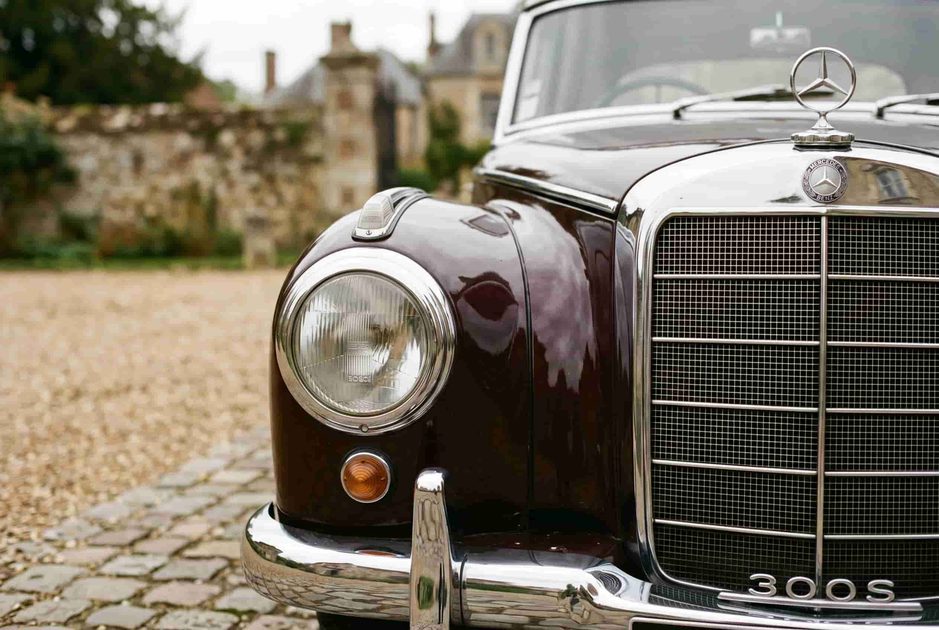
The great luxury cars of the mid-20th century understood this distinction at a molecular level. A Mercedes-Benz 300S, a Bentley S-Type, a Facel Vega—these were cars built for people who did not need to prove anything. Their exteriors were remarkably free of ornament. Their lines were drawn with a discipline that bordered on severity. Their designers understood that when a car is genuinely expensive to build, it does not need to look expensive. The substance is already there. Adding decoration would only dilute it.
This is the first principle that modern luxury has abandoned: the confidence to stop. To leave a surface unadorned. To let a proportion speak without a crease line underlining it. To trust that the right observer will recognize quality without being prompted by a badge the size of a dinner plate.
The Geometry of Understatement
Restraint in automobile design is not a vague sentiment. It has a geometry. It can be measured in the relationship between a car's wheelbase and its overhangs, in the thickness of its pillars, in the amount of glass relative to bodywork, and in the number of graphic elements on any single surface.
The cars that embodied old-world prestige tended to share certain proportional disciplines. They were long without being wide; they were low without being aggressive; they were formal without being stiff. Their front ends did not lunge forward. Their rear ends did not pinch into a wedge. They occupied space the way a well-dressed man occupies a room: with economy, not expansion.
Table: Old Restraint vs. New Excess
Design Element | Prestige Through Restraint (1950s-1970s) | Prestige Through Noise (Current Era) |
|---|---|---|
Grille | Vertical, proportionate, integral to the body | Oversized, dominant, isolated as a design statement |
Chrome trim | Thin, linear, used to define edges | Heavy, wide, used to fill surfaces |
Body surfacing | Smooth, taut, minimal creases | Aggressively sculpted, layered, and vented |
Wheel design | Modest diameter, tall sidewalls, understated faces | Enormous diameter, rubber-band tires, machined faces |
Badging | Small, tasteful, often limited to a single monogram | Large, illuminated, repeated across the body |
Exhaust | Hidden or subtly integrated | Prominent, shaped, and sometimes amplified digitally |
Interior lighting | Warm instrument glow, shadow-led design | Full ambient RGB, screen-dominant |
Overall posture | Horizontal, planted, patient | Crouched, tense, forward-lunging |
The cars on the left side of this table were not cheap. They were often extraordinarily expensive. But their expense was expressed through the quality of their engineering and the precision of their assembly, not through the volume of their styling. That distinction—between cost and showiness—is the entire difference between prestige and its counterfeit.
The Quiet Interiors
If restraint defined the exteriors of these cars, it absolutely governed their interiors. The cabin of a prestigious automobile was not designed to entertain. It was designed to transport—not just bodies, but mood. Everything in it was subordinated to a single aim: a sense of calm arrival.
Materials were chosen for their aging properties, not their showroom shimmer. Leather was left largely uncoated, so it would develop a patina. Wood was matte-finished or lightly oiled, so it would darken with use and time. Chrome was polished to a low luster, not a mirror glare. The result was an environment that felt built, not assembled—a room on wheels rather than a gadget on axles.
There were no screens. There were no haptic touchpads. There were switches that clicked with mechanical finality, knobs that turned with deliberate resistance, and vents that could be aimed by feel. A driver could operate every essential function without once looking away from the road. This was not a limitation of the era's technology; it was a considered philosophy. The car served the driver, and the driver's attention was not a resource to be harvested.
The Language of the Grille
No element of modern automotive design better illustrates the collapse of restraint than the grille. It has become the focal point of a car's face, absorbing every anxiety the manufacturer feels about its brand identity.
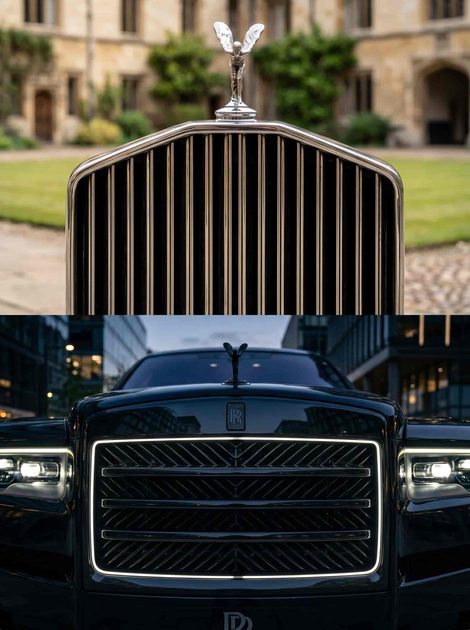
A grille in the restrained era had a job: to admit cooling air and to identify the marque. It was scaled to that job. The grille of a 1950s Mercedes 300 was a delicate chrome frame with horizontal bars. It sat upright and proud, but it did not dominate the front end. It was part of a composition, not the composition itself. The grille of a Bentley S3 was similarly modest—a matrix of fine mesh, bordered by thin chrome, integrated into a nose that was handsome without being aggressive.
Now look at a current luxury sedan. The grille has swollen to fill the entire front fascia. It is no longer a grille; it is a mask. It is frequently outlined in illumination, as if the manufacturer is afraid you might not notice it in daylight. Some grilles now feature active shutters that open and close with theatrical choreography. The function has become a performance, and the performance is always about status anxiety: Please see me. Please know what this cost.
The old grille did not beg. It stated. That is the difference between confidence and its absence.
What the Market Learned to Reward
If the old restrained prestige was so compelling, why did it disappear? The answer is not simple, but it begins with a shift in who luxury cars were being sold to—and what those buyers wanted the car to do.
For the majority of the 20th century, a luxury automobile was bought by someone who already had status. The car was a reflection of an established position, not a tool for achieving one. It did not need to announce anything because the person inside had already been announced, often literally, by a family name or a professional reputation. The car could afford to be quiet.
As the luxury market expanded globally, the buyer profile shifted. New wealth—liquid, fast, and unmoored from inherited taste—entered the market in large numbers. These buyers did not want a car that whispered. They wanted a car that told the valet, the neighbor, the business rival, and the algorithm exactly where they stood. The industry, sensing profit, obliged. Restraint became a niche. Noise became the default.
This is not a moral judgment on new money. It is an observation about the mechanics of taste. Taste requires time, and time is the one thing that rapidly accumulated wealth does not provide. The old prestige vehicles were shaped by decades of iterative refinement. Their successors are shaped by focus groups and quarterly earnings calls. The results are exactly what you would expect.
Restraint as a Living Option
I want to be careful here. I am not saying that every modern luxury car is tasteless, or that every old one was a masterpiece. There were vulgar cars in the 1950s, and there are restrained cars being built today. But the center of gravity has shifted so decisively toward noise that restraint is no longer a category; it is a counterculture.
A few manufacturers still understand the old language. Certain specifications of Bentley and Rolls-Royce, ordered by clients who know what to leave off. The less-is-more philosophy still visible in the work of a handful of independent coachbuilders. The quiet excellence of a well-maintained W126 Mercedes, still holding its own in any valet line forty years after it left Sindelfingen. These exceptions prove the rule, and the rule is that prestige no longer trusts silence.
The cars I write about on this blog are not all from the past. But they are all cars that understand something the present has largely forgotten: that the most enduring form of prestige is the kind that does not demand your attention. It simply stands there, composed and unapologetic, and waits for you to recognize it on your own terms.
That kind of restraint is not a stylistic choice. It is a moral one. And it is the only kind worth writing about.