
There is a species of automobile that enters a room—or a street, or a memory—and immediately begins performing. Its grille is too large for its face. Its exhaust note has been engineered into a theatrical cough. Its interior, bathed in ambient light strips, glows like the lobby of a nightclub that opened six months ago and will close in three. These cars arrive in a flurry of demanded notice, and for a moment, they get it.
Then there is the other kind. The car that does not raise its voice. The car that pulls up alongside you at a light in the rain and says nothing, yet somehow rearranges the air around it. You do not turn your head because an algorithm told you to. You turn because something in the proportion, the posture, the quiet integrity of the thing has registered at a frequency beneath language.
This distinction—between demanding attention and keeping it—is the aesthetic spine of everything I write here. It is not a preference. It is, I have come to believe, the only reliable test of whether a machine will be remembered.
The Anatomy of Attention
To understand the difference, it helps to be precise about what we mean.
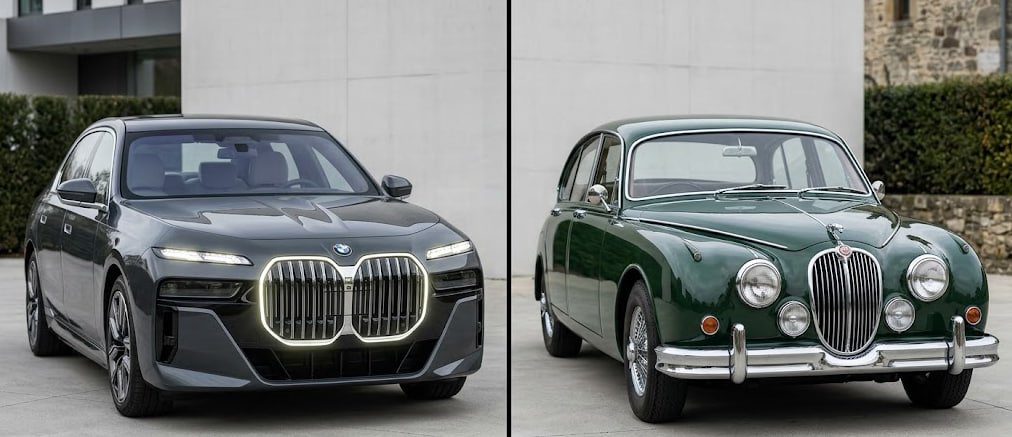
Demanding attention is an act of anxiety. The oversized grille does not trust that you will notice it on its merits, so it inflates. The aggressive diffuser does not believe the car's shape will hold the eye, so it adds visual shouting. The illuminated emblem does not have faith that the marque's reputation will precede it, so it lights itself up like a notification. These are the gestures of machines that fear being overlooked. And the fear is not irrational—because what they are offering, beneath the noise, is often very little.
Keeping attention is an act of confidence. It assumes that if you take a second look, you will be rewarded. It trusts proportion over decoration. It understands that the human eye is not fooled for long by flash, but will return endlessly to something that feels right in ways it cannot immediately explain.
Table: Demanding Attention vs. Keeping Attention
Design Element | Demands Attention | Keeps Attention |
|---|---|---|
Grille | Oversized, glossy, shaped to provoke | Scaled to the car's face, honest in material, resolved |
Interior lighting | RGB strips, screen-dominant, nightclub effect | Warm instrument glow, deliberate shadows, analog clarity |
Body surfacing | Creased for drama, trend-driven, photogenic but unresolved in person | Subtle, taut, rewarding over time and across light conditions |
Brand signifiers | Illuminated emblems, oversized badges, repeated logos | A single tasteful crest, or none at all |
Sound | Synthesized, amplified, designed for the bystander | Mechanical, honest, designed for the cabin |
Lifecycle of impression | Immediate, loud, exhausting within months | Slow-build, deepening over years |
What the table reveals is that attention-demanding design is fundamentally extractive—it takes from the viewer's patience, goodwill, and sensory bandwidth. Attention-keeping design is generous: it gives back more the longer you look.
Why Quiet Cars Win Over Time
The automobiles that hold attention across decades share a set of common disciplines. They are rarely the most expensive cars of their era. They are rarely the fastest. They are the cars whose creators understood three things that most manufacturers have now forgotten.
First, proportion is the only aesthetic argument that survives. Horsepower numbers become obsolete. Infotainment systems become embarrassing. But the relationship between the hood, the cabin, and the tail—the way a car sits on its axles, the way its glass meets its metal—that relationship ages or it doesn't. A well-proportioned car at twenty years looks composed. At forty years, it looks inevitable. Look at a Series 1 Jaguar XJ in traffic today. It does not demand that you notice it. But once you do, you cannot look away, because every line is doing exactly what it should.
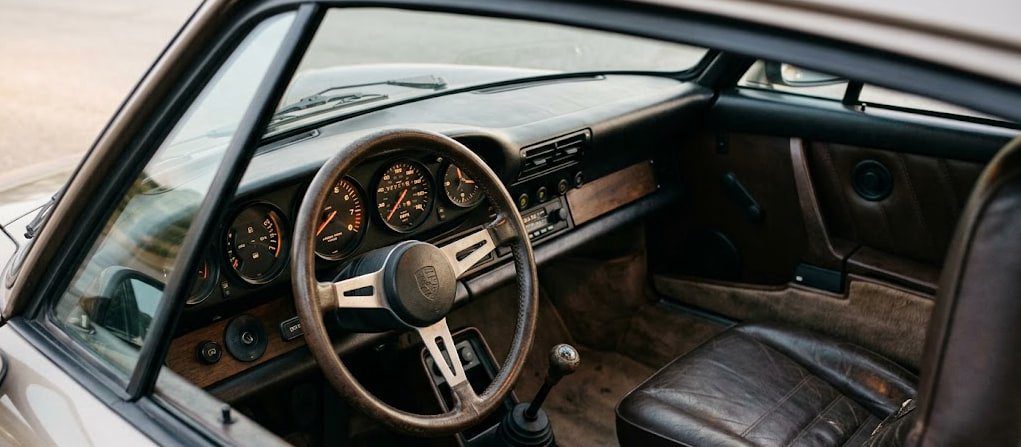
Second, material honesty compounds while material fakery decays. Open-grain wood that was wood when the car was new will be wood when the car is fifty. Chrome that was metal when it left the factory will pit, dull, and polish back to life—it will tell a story. But soft-touch plastic delaminates. Faux carbon fiber looks sarcastic after a single generation. The materials that keep attention are the ones that were never pretending.
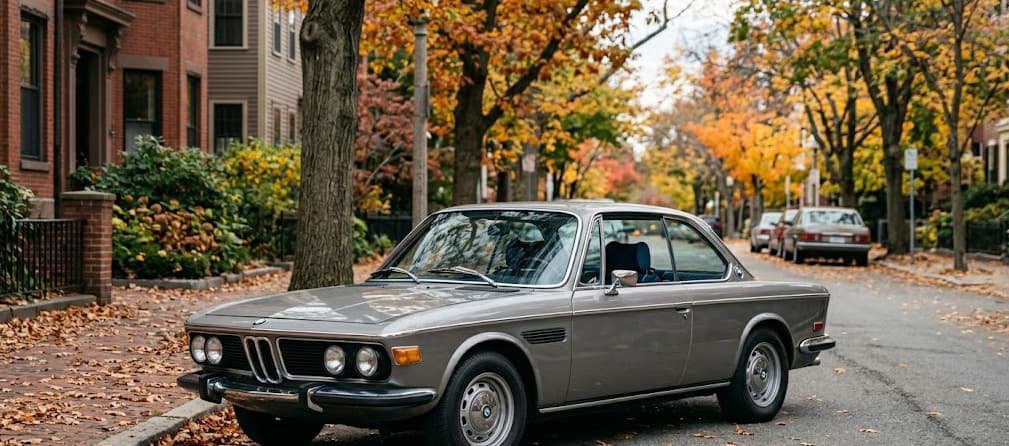
Third, restraint creates room for the observer. A car that fills every surface with ornament, crease, and graphic detail leaves nothing for the eye to discover. A car that exercises restraint—that leaves a panel unbroken, a surface calm, a detail small and considered rather than large and broadcast—invites you in. It makes the act of looking participatory rather than passive. This is why a Mercedes W111 coupe can occupy your attention for an hour, while the latest maximalist SUV exhausts it in thirty seconds.
The Logo That Glows in the Dark
Let me give you a concrete example of the disease, because precision matters.
A certain German manufacturer—one whose older machines I admire deeply—now offers an illuminated grille emblem on its flagship sedan. When the car is locked, the emblem pulses faintly. When the car approaches, the emblem brightens. The driver is not meant to see it. The driver is inside the cabin. This emblem exists entirely for the bystander, the pedestrian, the valet, the other driver at the light. It is a piece of design whose sole function is to announce: I am a brand. Acknowledge the brand.
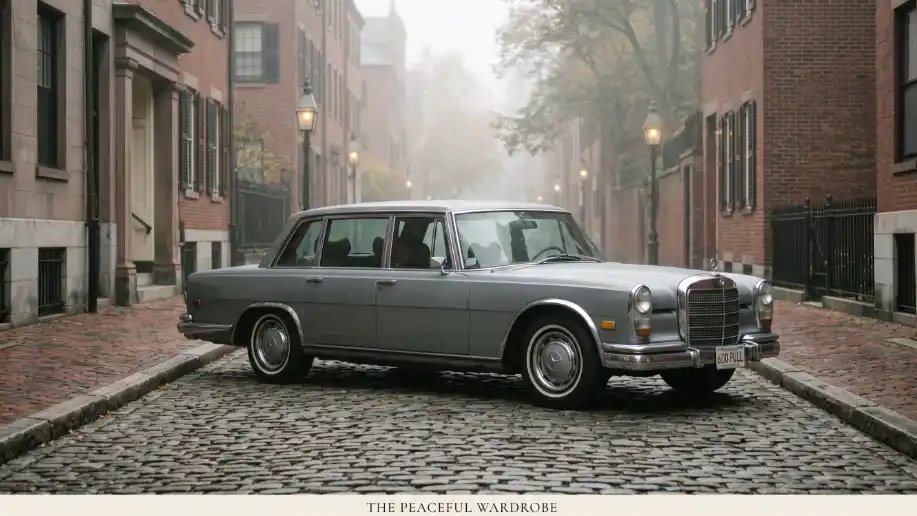
Compare this to the grille badge on a 1960s Mercedes 600. It is small. It is chrome. It sits at the top of a radiator shell that was hand-assembled and tuned to fit with jeweler's precision. It does not light up. It does not pulse. It simply states the marque—three points, a laurel—and trusts that if you know, you know. And if you don't, the car is not going to embarrass itself by explaining.
One of these approaches treats the observer as a mind to be respected. The other treats the observer as a pair of eyeballs to be captured. The difference is everything.
The Quiet Car as a Moral Position
I want to be clear about something. I am not arguing that all modern cars are bad. I am not arguing that performance is irrelevant. I am arguing that the loudness—the aesthetic panic—that has overtaken automotive design in the last fifteen years is not a stylistic preference. It is a symptom.
It is a symptom of manufacturers who no longer trust their own heritage. It is a symptom of a culture that confuses presence with noise. And it is a symptom of an audience that has been trained, by algorithms and by the endless scroll, to respond only to things that interrupt.
The quiet car is not a car that does nothing. It is a car that does everything it needs to do without begging you to notice. It is a car built by people who believed that the right buyer would find it, and that the wrong buyer did not need to be convinced. That kind of confidence—the confidence to keep your voice low because what you are saying is worth hearing—is not just rare in automobiles now. It is rare everywhere.
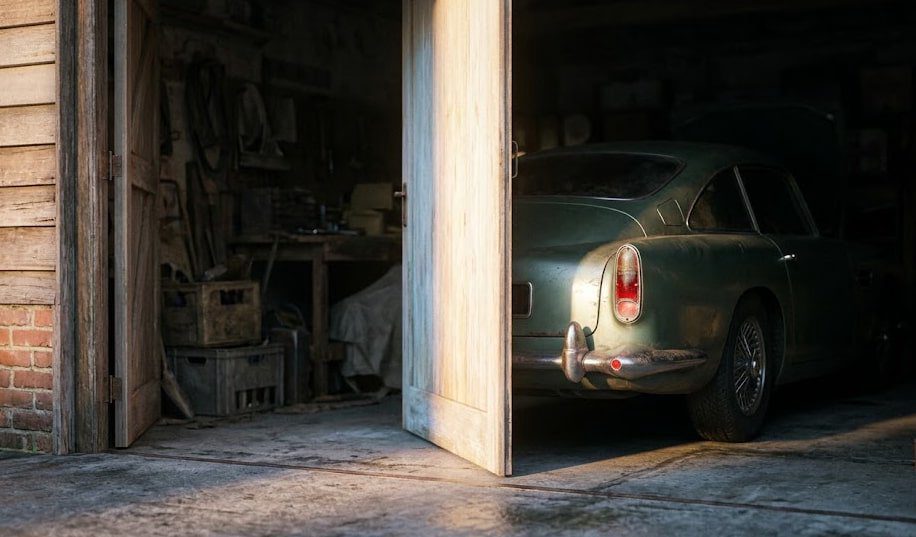
What This Means for This Blog
The signature line you see at the top of this essay is not decorative. It is the standard against which every observation here will be measured. When I write about a dashboard, I will ask: does it demand attention, or does it hold it? When I examine a film's use of an automobile, I will ask: is the car being used as a prop for noise, or as a character with its own restrained presence? When I describe a drive, I will write not about the moments when the car demanded something of the road, but about the moments when the car and the road and the driver fell into a silence that felt earned.
This is not a blog for people who want their taste validated by volume. It is a blog for people who have begun to suspect that the most interesting things in the world are the ones that are not trying to be noticed at all.
The best cars do not demand attention. They keep it. And so, I hope, will this space.