
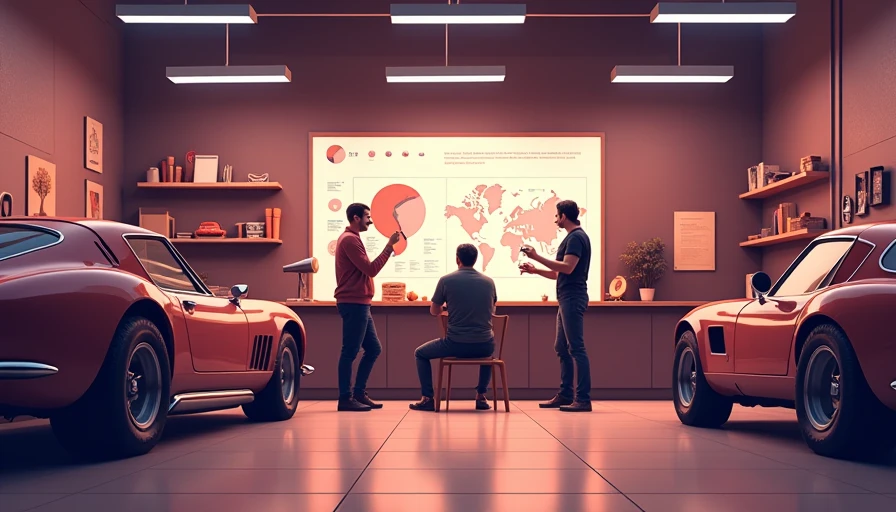
Great cars are not merely engineered; they are sculpted. While horsepower figures and lap times dominate headlines, it is the line of a fender, the curve of a roofline, and the proportion of a greenhouse that linger in memory long after the key is turned. To speak of the greatest car designers of all time is to acknowledge those rare individuals who turned transportation into emotion. Their work transcends brand loyalties and model generations. It becomes the visual language of aspiration itself.
Battista Pininfarina: The Architect of Elegance
No list of the greatest car designers of all time is complete without Battista Pininfarina. Born in 1893, he founded Carrozzeria Pininfarina in 1930 and soon established a house style defined by harmony, proportion, and restraint. His partnership with Ferrari began in 1951 with the 212 Inter and continued through icons like the 250 GT California Spider and the 365 Daytona. Pininfarina understood that elegance is not ornament but the absence of it. His designs feel inevitable, as if the wind itself shaped them. The Ferrari 250 GTO, while not a Pininfarina design, shares that ethos, but it is the 1968 Ferrari 365 GTB/4 that many consider the studio’s masterpiece: a long hood, a fastback roof, and a Kamm tail that resolved speed into sculpture.
Giorgetto Giugiaro: The Prolific Visionary
If Pininfarina defined aristocratic grace, Giorgetto Giugiaro gave us the modern car. His career at Bertone and later Italdesign produced some of the most recognizable shapes of the twentieth century. The Volkswagen Golf Mk1, the Maserati Bora, the DeLorean DMC-12, and the BMW M1 all bear his hand. Giugiaro’s genius lay in packaging: he could take a set of mechanical requirements and translate them into a fresh, coherent form. The Golf’s wedge profile and upright cabin set the template for the hatchback for decades. Among the greatest car designers of all time, Giugiaro is arguably the most influential in terms of sheer volume and market impact.
Sergio Scaglietti: The Sculptor in Metal
Sergio Scaglietti was not a trained designer but a master coachbuilder. His workshop in Modena hand-formed the aluminum bodies for Ferrari’s most celebrated competition cars of the 1950s and 1960s. The Ferrari 250 Testarossa, 250 TR, and 250 California Spyder (the short-wheelbase version) were all Scaglietti creations. He worked with hammer and English wheel, coaxing metal into organic shapes that seemed to flex with muscle. His designs are raw and immediate, less polished than Pininfarina’s but brimming with life. To call him one of the greatest car designers of all time is to honor the craft of shaping metal by hand. His work reminds us that great design does not always come from a drawing board.
Ian Callum: The Modernist
Ian Callum brought a distinctly British sense of proportion to Jaguar, Aston Martin, and later his own firm. At Jaguar, he penned the C-X75 concept and the F-Type, a car that channels the lineage of the E-Type without resorting to nostalgia. His earlier work at Aston Martin — the DB7, Vanquish, and DB9 — established a design language that balanced aggression with elegance. Callum’s interiors are equally thoughtful, with driver-focused cockpits that prioritize tactility. In a world that increasingly values visual noise, Callum’s restraint is a quiet rebellion. He belongs in any discussion of the greatest car designers of all time because he proved that modernism can be emotive.
Marcello Gandini: The Edge of Drama
Marcello Gandini succeeded Giugiaro at Bertone and immediately pushed the boundaries of proportion. The Lamborghini Miura, Countach, and Lancia Stratos defined the dramatic wedge aesthetic of the 1970s. The Miura’s horizontal, mid-engined silhouette was a revelation; the Countach’s scissor doors and angular bodywork made every other sports car look meek. Gandini understood theater. His designs are not subtle, but they are purposeful. The Countach’s sharp lines were dictated by aerodynamic testing and the need to cool a massive V12. Gandini’s work continues to influence hypercar design to this day. He remains a favorite among enthusiasts who love the dramatic end of the spectrum.
Henrik Fisker: The Modern Sculptor
Henrik Fisker is a Danish-born designer whose career spans Aston Martin, BMW, and his own automotive ventures. At Aston Martin, he penned the DB9 and V8 Vantage, two cars that redefined the brand’s modern identity with taut surfacing and perfect proportions. The DB9’s graceful elongation and the Vantage’s muscular compactness showcased his ability to adapt a design language to different segments without losing coherence. Later, at Fisker Automotive, he created the Karma, a plug-in hybrid that married eco-consciousness with dramatic styling — low, wide, and aggressive. The Karma’s lines were clean yet bold, with a prominent grille and sweeping rear haunches. Fisker’s work proves that modern designers can balance performance, sustainability, and emotion. Though not as prolific as Giugiaro, his best designs are instantly recognizable and deeply influential. He belongs among the greatest car designers of all time because he consistently delivered beauty under the constraints of modern engineering.
The Lasting Legacy
The greatest car designers of all time do not merely create shapes; they create memories. Each name on this list — Pininfarina, Giugiaro, Scaglietti, Callum, Gandini, Fisker — shaped the way we see the automobile. Their best works feel timeless, worthy of the same admiration we reserve for art. As you consider the next car you will own, ask yourself not only how fast it will go, but how it will make you feel when you look back at it from the sidewalk. That feeling is the designer’s gift, and it is what makes their craft so important.