

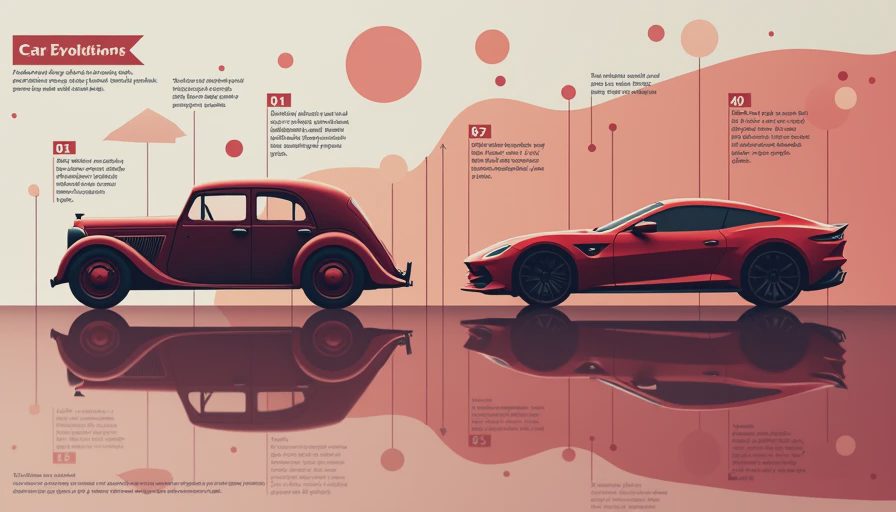
There is a quiet argument in every driveway. It is an argument between the past and the future, between what we remember and what we imagine. The evolution of the car, when traced through the lens of design and memory, is not a simple story of better engines or faster acceleration. It is a story of how we decided to see ourselves on the road. To understand that story is to understand a century of cultural longing wrapped in steel, glass, and a little chrome.
The Birth of Form and Function
In the earliest days, the car was little more than a motorized carriage. The Ford Model T, introduced in 1908, was a marvel of production efficiency, but it was also a design born of necessity. Its high ground clearance, narrow tires, and exposed mechanical bits were not choices in the way we think of them today. They were answers to mud, rutted roads, and a blacksmith’s pragmatism. Yet even then, there was a hint of something more. The curved dash, the simple arc of the fender—these were the first quiet gestures of a machine learning to carry not just bodies, but aspirations. The evolution of the car began not with a leap of imagination, but with a step of utility.

The Golden Age of Expression
By the 1930s, the car had shed its utilitarian skin. Designers like Harley Earl at General Motors understood that a car could sell on its look alone. The 1961 Jaguar E-Type, often called the most beautiful car ever built, crystallized this shift. Its long hood, teardrop headlights, and taut rear haunches were not there to improve aerodynamics alone. They were there to stir something in the observer. This was the moment when the evolution of the car became an emotional one. Curves softened, chrome glittered, and the car became a sculpture in motion. It was a time when designers treated steel like clay and believed that every line mattered.
Efficiency and Structure
The oil crises of the 1970s forced a reckoning. Suddenly, the heavy, flamboyant shapes of the previous decade felt not just indulgent, but irresponsible. The evolution of the car took a new turn toward rationality. The 1974 Porsche 911—though its basic silhouette predated the crisis—became a symbol of how efficiency and emotion could coexist. Its rear-engine layout and unforgiving weight distribution were not friendly, but its shape was so resolved that decades later it still looks modern. The 1980s brought boxy, aerodynamic forms like the Audi 100 and the Ford Taurus, which prioritized function over flourish. Yet even in these rational years, the best designers understood that a car’s shape must still speak. It just learned to speak more softly.
The Modern Synthesis
Today, the evolution of the car is both more complex and more cautious than ever. Electric powertrains have erased the need for large front grilles. Batteries sit low in the floor, pushing proportions toward a cab-forward stance. The Tesla Model S, introduced in 2012, proved that an electric car could be both beautiful and desirable, its face clean and almost serene. Yet there is a tension now. Designers must balance heritage with aerodynamics, brand identity with the blank canvas of a new drivetrain. The best contemporary cars—the Porsche Taycan, the new Range Rover, the Ferrari Roma—resolve this tension with restraint. They do not shout. They whisper.
What the Next Shift Holds
The evolution of the car is never finished. It circles back on itself, reinterpreting old themes with new materials. The revival of side-sculpted surfacing on recent electric sedans echoes the coachbuilt granite of the 1930s. The return of single-pane glass roofs and hidden door handles pulls from the streamlined dreams of the 1950s. We are not leaving the past behind; we are carrying it forward, refined and reimagined. The best cars do not demand attention. They keep it—and in that quiet steadiness, they remind us that the evolution of the car is really an evolution of what we want to remember.
A Driver’s Checklist for Appreciating Automotive Design Evolution
To truly connect with the evolution of the car, try this hands-on approach next time you visit a showroom or a classic car gathering. First, stand at the side of the vehicle and study its proportion. The distance from the front wheel to the base of the windshield tells you whether the car was built for speed or comfort. Second, run your eye along the fender line—does it flow in a single unbroken curve or does it break into multiple surfaces? The uninterrupted sweep of a Jaguar E-Type fender is a masterclass in elegance. Third, examine the car’s face: the grille, headlights, and bumper. Compare an older car’s expressive chrome grille to a modern electric car’s smooth panel. Fourth, look at the door handles—are they flush or protruding? Hidden handles signal a shift toward aerodynamic purity. Fifth, sit inside. The cabin’s layout, the feel of the steering wheel, the way the dashboard wraps around you—these details reveal the designer’s intent. By following these steps, you engage with the evolution of the car not as a passive observer, but as an active student of craft.