
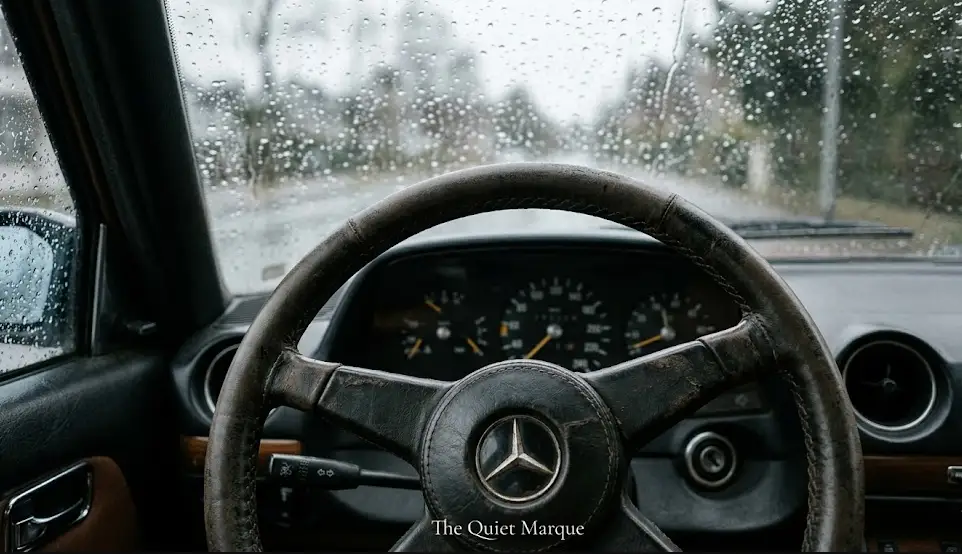
The internet does not need another car blog. It does not need another list of lap times, another exhaust-note decibel comparison, another render of a hypercar that will exist for twelve men in climate-controlled garages. What it needs—if anything—is a place where automobiles are read as texts, not specs. Where a dashboard is understood as a moral document, and a well-judged roofline carries the same weight as a well-cut shoulder.
That is why this space exists.
Most automotive coverage now assumes you are either a collector hunting the next asset, an enthusiast chasing the next dopamine hit, or a commuter waiting to be told what to lease. The Quiet Marque assumes none of those things. It assumes you have noticed that some cars age into language while others simply grow old. It assumes you have felt, without necessarily articulating, that the cabin of a certain Mercedes sedan can quiet the mind in a way that most modern interiors actively prevent. It assumes you are more interested in why a machine means something than in what it costs or how quickly it launches from a standstill.
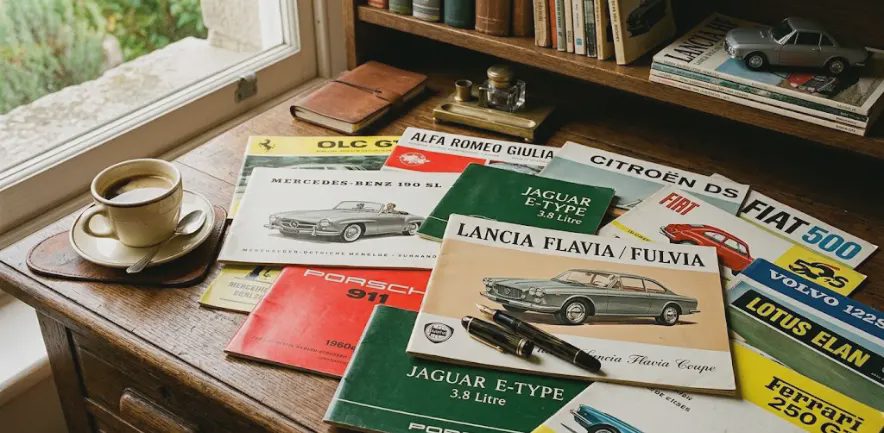
I am not a journalist. I am not an influencer. I am a private observer who has spent years studying the automobile as a cultural artifact—through driving, collecting old brochures, reading engineering histories that no algorithm would ever surface, and watching how certain cars behave in film, in memory, and in the hands of those who keep them. I live in Boston, a city where old-money restraint and Atlantic weather have a way of teaching patience. I write alone, late, often with music playing. I do not produce content for the feed.
This blog is named for the marques that do their best work quietly. It borrows its signature line from a conviction I find increasingly rare: The best cars do not demand attention. They keep it. That sentence is not a slogan. It is the organizing principle behind every observation you will find here.
If you have arrived expecting hot takes on the latest SUV coupe or arguments about who won a horsepower war, you will be disappointed. But if you have ever paused over the typeface in a 1960s brochure and thought, “they were writing to a different man”—this is your place.
What This Space Will Cover
The writing here is organized around four recurring observations, each of which will appear with its own rhythm.
Marque & Memory looks at heritage automakers not as balance sheets but as carriers of cultural inheritance. Why do certain Mercedes sedans still feel more civilized than anything built since? What did old BMWs possess that felt intellectual before it felt aggressive? When did Jaguar mean taste rather than theater?
Cinema, Style, and Steel reads the car as a garment. It traces the discipline of proportion from a Huntsman suit to a Series 1 Jaguar XJ. It asks why some automobiles dress better than the men who own them, and what film noir understood about automotive presence that social media never will.
Road, Ritual, Solitude is the most personal section. It records the interior life of driving: night roads, classical music, the strange calm of winter tarmac and rear-wheel drive. This is where the blog is least interested in being useful, and most interested in being true.
Objects of Character trains its attention on the details. Steering wheels that told you everything about an era. Knobs that clicked with mechanical finality. Leather that ages, wood that darkens right, chrome that understood exactly when to stop. These small decisions, I have learned, are where character is actually built.

A Brief Note on Method
I do not chase relevance. I do not review press cars. I do not attend launches or write about what the manufacturers want you to see this week. My primary sources are the cars themselves, the printed material that accompanied them when they were new, the films that used them as set design, and the owners who have lived with them for decades. Where I offer judgment, it is earned through observation, not borrowed from a press release.
This site will never run advertisements designed to interrupt reading. It will never hawk affiliate links disguised as recommendations. My credibility—and your attention—are worth more than a short-term commission on a leather conditioner. If you are looking for the trustworthiness that comes from genuine independence, you will find it here.
A Question Worth Answering
You might fairly ask: how is this different from the few good automotive culture publications that already exist?
Table: What Distinguishes The Quiet Marque
Aspect | Typical Automotive Media | The Quiet Marque |
|---|---|---|
Primary Unit of Value | News, specs, market analysis | Character, proportion, cultural memory |
Voice | Urgent, crowd-pleasing, often performative | Restrained, observant, precise |
Treatment of the Car | Machine to be tested or collected | Artifact to be read and inherited |
Relationship to Time | Chasing the next release cycle | Dwelling on what endures |
Audience Assumed | Buyers, enthusiasts, speculators | People who see cars as extensions of identity, memory, and taste |
The publications I admire—Hagerty’s better essays, certain pieces in Road & Track, the archive of Petrolicious—carry real cultural weight. What this blog offers is a single, consistent voice. It does not pitch a tent at every trend. It trusts that a man in Boston, writing with care about a 1972 cabin light he noticed at dusk, can say something lasting.

What This Blog Will Not Do
It is as important to name what a space rejects as what it embraces. The Quiet Marque will not:
Publish listicles that rank cars by zero-to-sixty times
Use the vocabulary of hype—no “game-changer,” no “iconic” deployed as filler, no exclamation points
Reduce a machine to its auction estimate
Pretend that speed alone is a cultural argument
Confuse luxury with taste
Luxury shouts; taste murmurs. A great deal of modern automotive design has mistaken the first for the second. This blog will not make that mistake.
A Quiet Invitation
If you have read this far, you likely already know whether this space is for you. It will not publish daily. It will not summarize what you missed. It will write about cars the way some men write about architecture or jazz: as systems of character, proportion, and inheritance.
The first series of essays will walk through the ideas that form this project’s skeleton: the civilized Mercedes, the dashboard as a moral document, the pleasure of driving without an audience. Later, we will move deeper into the archive, into the films, into the tailoring, and into the private rituals that give car ownership its emotional weight.
I am not here to convince you. I am here to write what I see, with as much precision as I can, for as long as it remains worth doing.
Welcome to The Quiet Marque.