

I have my clothing made by a tailor. Not because I enjoy the process—I am impatient in fittings, and I find mirrors tiresome—but because I have learned that proportion is not something you can buy off a rack. A jacket that fits one man perfectly will hang on another like an accusation. The difference is not in the fabric, the brand, or the price. It is in the relationship between the garment and the body it covers.
This same discipline governs the automobiles that last. The best cars are not the fastest, the most expensive, or the most lavishly appointed. They are the ones that get their proportions right: the length of the hood relative to the cabin, the height of the glass relative to the body side, the stance of the wheels within their arches, the visual weight of the front versus the rear. These relationships are the automotive equivalent of a shoulder line. When they are correct, the car looks inevitable. When they are wrong, no amount of horsepower or leather can save it.
The link between tailoring and automobile design is not a metaphor. It is a shared language of line, weight, restraint, and judgment. And it is a language that fewer and fewer manufacturers appear to speak.
The Shoulder Line
In tailoring, the shoulder is where everything begins. A natural shoulder, lightly padded and sloping, conveys ease. A roped shoulder, structured and squared, conveys formality. A shoulder that is too wide becomes a costume. A shoulder that is too narrow becomes a suit its wearer has outgrown. The shoulder sets the terms for everything that follows: the drape of the chest, the hang of the sleeve, the line of the back.
A car has a shoulder, too. It is the line that runs from the base of the A-pillar through the top of the front fender and into the door. On some cars, this line is soft and rounded, almost invisible—a Bentley S3 Continental, say, which wears its bodywork like a cashmere overcoat. On others, it is sharp and deliberate, a crease that defines the entire flank, as on a BMW 3.0 CSi. The shoulder line tells you immediately what kind of car you are looking at, and what kind of man it expects you to be.
The modern performance sedan often makes the mistake of a too-wide shoulder. Its fenders flare aggressively, its haunches bulge, its bodywork looks like it is trying to escape the chassis. This is the automotive equivalent of a suit jacket that pulls at the button. It is not powerful. It is uncomfortable. A car that is sure of its strength does not need to bulge to prove it.
The Cut of the Glass
If the shoulder is where the car's jacket begins, the greenhouse—the glass area above the beltline—is where its collar and lapel sit. This is the most legible part of the car's proportion, and the one most frequently ruined.
In tailoring, the relationship between the jacket's lapel and the wearer's neck and chest determines whether the whole garment reads as balanced. A lapel that is too wide for the chest looks faddish. A lapel that is too narrow looks stingy. The correct width is not a number; it is a judgment made against the body that will wear it.
The greenhouse operates in the same way. It must be tall enough to provide visibility and a sense of airiness, but not so tall that the car reads as top-heavy. It must be low enough to convey purpose, but not so low that the windows become gun slits and the cabin becomes a cave. The old Mercedes sedans understood this perfectly. Their greenhouses were generous and upright, the glass nearly vertical, the pillars thin. You sat in them, not down in them. The view out was a privilege the car extended to you.
Contrast this with the current fashion for high beltlines and chopped rooflines. The modern luxury car often looks like it is wearing its collar turned up and its hat pulled low. It is all mood and no manners. It hides its occupants rather than presenting them. This is not proportion. It is posture, and it is defensive.
Table: The Language of Proportion in Tailoring and Automobiles
Element | In Tailoring | In Automobile Design | What It Communicates |
|---|---|---|---|
Shoulder | Natural, padded, or roped; width relative to frame | Front fender line from A-pillar into the door; shoulder crease | Ease, formality, aggression, or anxiety |
Lapel / Greenhouse | Width, notch placement, gorge height relative to chest | Glass-to-body ratio, pillar thickness, beltline height | Openness, confidence, or defensiveness |
Drape / Body Side | How the fabric hangs from the shoulder, chest, and back | Door panel surfacing; tension or slack in the sheet metal | Fluidity, weight, or stiffness |
Trousers / Rear | Rise, leg width, break over the shoe | Rear overhang length, taillight height, bumper treatment | Balance, formality, or visual acceleration |
Cuff / Wheel Opening | Trouser break, cuff width, relationship to shoe | Wheel-to-arch gap, wheel diameter, tire sidewall height | Stance, purpose, and whether the car sits properly on its suspension |
The Drape of the Body Side
In a bespoke suit, the area between the shoulder and the waist is where the cutter's art is most visible. A well-cut chest drapes: the fabric follows the body without clinging to it, falling cleanly from the shoulder and breaking softly at the waist. There is air between the cloth and the shirt. This air is the difference between a suit that fits and a suit that simply covers.
A car's body side must perform the same trick. The sheet metal must cover the mechanicals and the occupants without looking stretched over them. It must have tension without tightness. The door skins must be taut but not slabby. There must be enough surface to reflect light gracefully, but not so much that the car looks inflated.
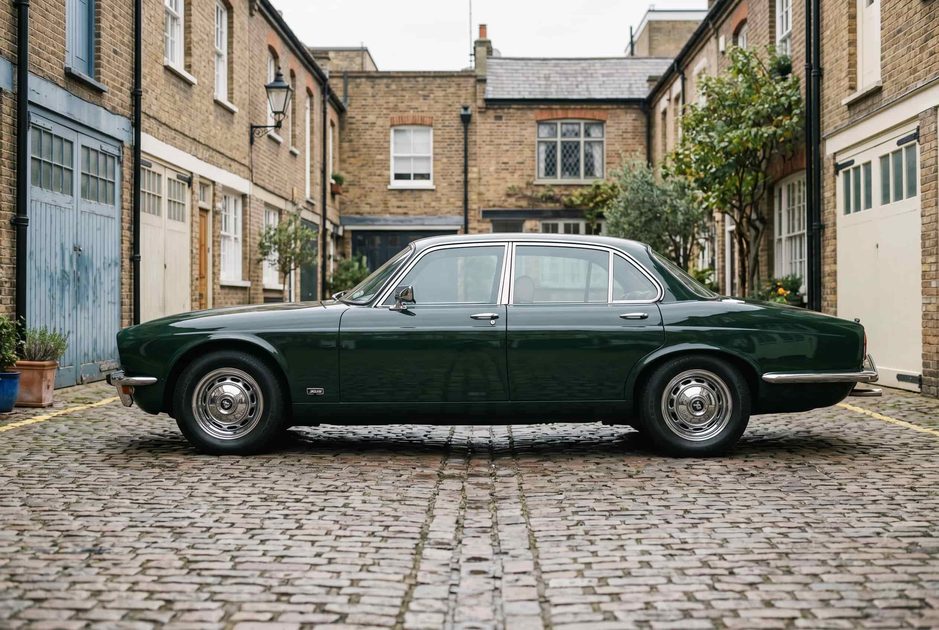
Consider the Jaguar XJ. The original Series 1, launched in 1968, has body sides that are almost entirely unadorned. A single chrome strip runs the length of the car, defining the waist. Below it, the metal falls away cleanly to the sill. Above it, the glass rises in a smooth curve. There are no fake vents, no strakes, no creases that lead nowhere. The car's beauty is in the tension of the surface itself, the way it wraps the engineering without revealing the effort. This is the automotive equivalent of a jacket that fits so well you forget the tailor exists.
The Trouser Break and the Rear Overhang
The most common mistake in off-the-rack suiting is the trouser break: the way the trouser leg meets the shoe. Too much fabric pooling at the ankle looks careless. No break at all—the current fashion for cropped trousers—looks like the wearer is expecting a flood. The correct break is a small, single fold, just enough to signal that the garment is resting, not collapsing.
The automobile has its own equivalent: the rear overhang and the way the rear bumper meets the body. On a car with disciplined proportions, the rear end completes the line without dragging it. The tail does not droop. The bumper does not protrude anxiously. The trunk lid closes with a visual finality that balances the hood at the other end of the car.
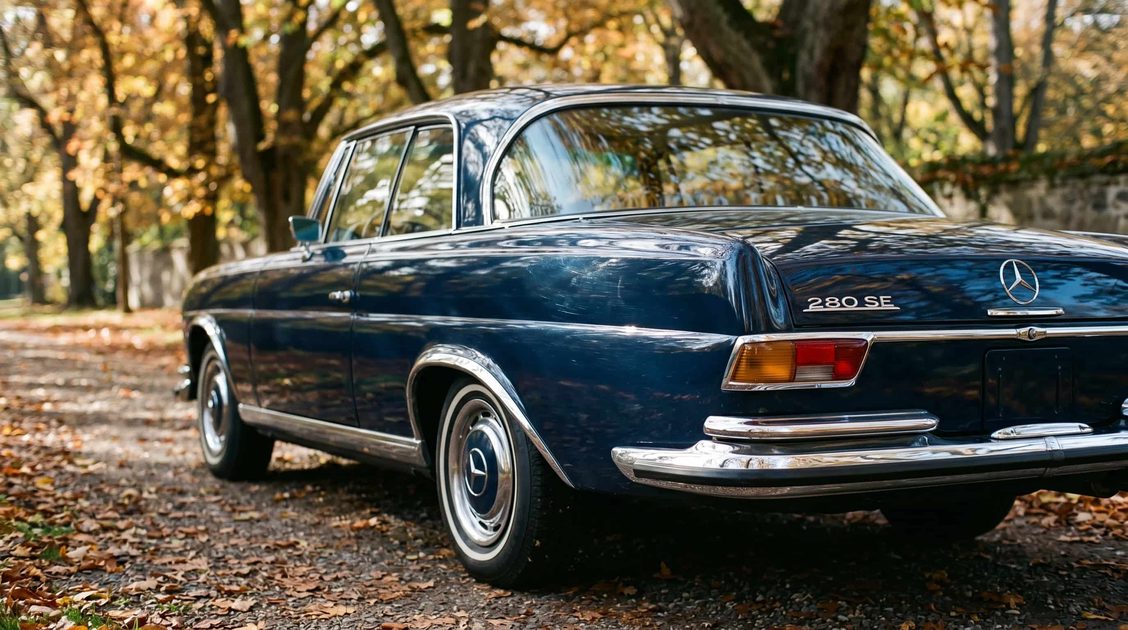
The old Mercedes W111 coupe is a masterclass in this balance. The rear overhang is generous but not excessive. The tail tucks under with a chrome bumper that is integrated, not bolted on. The visual weight of the rear matches the visual weight of the front. The car sits level. It does not crouch. It does not squat. It simply occupies its length with the composure of a man who has stopped worrying whether his trousers are breaking correctly—because they are.
The Cost of Losing Proportion
When a manufacturer loses the discipline of proportion, the result is a car that cannot keep attention once the initial shock wears off. The oversized grille, the pinched greenhouse, the rear that looks grafted on rather than grown—these are not merely ugly details. They are proportional failures, and they register at a level that even the untrained eye perceives.
The reason is straightforward. Human beings are exquisitely sensitive to proportion because we have spent millions of years judging the proportions of faces, bodies, and animals to assess health, strength, and threat. A face with features in the wrong relationship reads as untrustworthy or ill, even if we cannot articulate why. A car with its visual masses in the wrong relationship reads as unresolved, and the same unconscious machinery that judges a face judges the car.
The manufacturers who understood proportion—Mercedes in its W111 and W126 eras, Jaguar under Lyons, BMW before Bangle, Pininfarina across decades—were not simply making beautiful objects. They were aligning their work with deep perceptual truths. They were honoring the same principles that govern a well-cut suit, a well-proportioned room, a well-composed photograph. They were practicing a discipline that has no formula, only judgment.
Tailoring as a Way of Seeing
I did not set out to connect automobiles and tailoring. The connection made itself, over years of noticing that the same words kept appearing in both worlds: line, weight, balance, cut, proportion, restraint. When a tailor speaks of a jacket having "a beautiful line," he means something very close to what a designer means when he speaks of a car's roofline. Both are describing an arrangement of matter that pleases the eye without the eye quite knowing why.
This blog is, in part, an attempt to recover that way of seeing. To treat the automobile not as a gadget, a weapon, or an asset, but as a garment for motion. A car, like a suit, either fits its purpose or it does not. Either it flatters its wearer or it exposes him. Either it ages into a trusted companion or it dates itself into the back of the closet.
The discipline of proportion is not a set of rules. It is a habit of attention. It is the willingness to look at a machine and ask not how fast it goes, but how well it wears.