
I still remember the afternoon I parked my 1986 911 Targa on a gravel lot by Lake Michigan, stepped out to photograph the reflection of clouds on its rear quarter, and realized the watch on my wrist—a vintage Heuer Autavia—echoed the same philosophy of purposeful design. That moment crystallized something I had long suspected: the best watches for car enthusiasts are not merely accessories. They are mechanical analogues to the vehicles we love, sharing principles of engineering, material honesty, and the quiet pursuit of performance.
A car enthusiast's appreciation often extends beyond horsepower figures. It lives in the weight of a door handle, the grain of aluminum trim, the diameter of a steering wheel. A good watch offers the same kind of tactile satisfaction. The crown screws down like a fuel cap. The bezel clicks with the precision of a gear change. The dial reads at a glance, like a gauge cluster in your peripheral vision.
Shared Principles of Design and Engineering
Open the door of a well-resolved sports car and you will find visual themes repeated in a thoughtful watch. The symmetry of a dashboard echoes the balance of a dial. The sweep of a tachometer needle mirrors the smooth motion of a chronograph hand. Both industries rely on material selection that balances weight, durability, and beauty. Brushed steel, applied indices, anti-reflective crystals—these are not just cosmetic choices; they are the result of decades of refinement. When you choose the best watches for car enthusiasts, you are selecting objects that have been shaped by the same design sensibilities that govern automobile aesthetics.
Consider the Heuer Carrera, named after the Carrera Panamericana race. Its clean, legible dial was designed for rally driving, where split-second timing matters. Or the Rolex Daytona, with its tachymeter bezel calibrated to measure average speeds up to 400 km/h. These are not coincidences. The watchmakers understood that a driver needs to read time and elapsed intervals without distraction. That clarity, that refusal to ornament unnecessarily, is what makes these watches so resonant.
The Watch as an Extension of the Car Culture
Beyond shared design principles, certain watches have become inextricable from automotive culture. The TAG Heuer Monaco, with its square case and automatic chronograph movement, is forever linked to Steve McQueen and the film Le Mans. The Omega Speedmaster Professional, while famous for the moon landing, also has deep roots in motorsport timing—its early calibers were used in rally racing. For a car enthusiast, wearing such a watch is a statement of belonging to a lineage of performance and risk. But not every automotive-inspired watch needs a racing pedigree. Some watches simply evoke the mood of a particular car. The muted tones of a Jaeger-LeCoultre Reverso, for example, recall the understated elegance of a silver Mercedes-Benz 300SL. The bold numerals of a Panerai Luminor feel right at home in a Jeep Wrangler or a Land Rover Defender. The best watches for car enthusiasts are those that feel like a natural extension of their daily driver.
Choosing a watch that reflects your car—or the car you aspire to own—adds another layer of meaning to both objects. I know a man who drives a pale blue E-type Jaguar and wears a stainless steel IWC Mark XVIII. The simplicity of the instrument panel on his car matches the clean pilot-watch dial. It is not the most expensive watch in his collection, but it is the one that feels most honest. That honesty is what car people recognize.
Choosing a Watch That Reflects Your Driving Style
Not every enthusiast needs a chronograph or a racing-inspired model. The key is to match the watch to the character of the car and your own relationship with driving. For the owner of a modern supercar—a McLaren 720S or Ferrari F8 Tributo—a modern skeletonized watch like a Hublot Big Bang or Richard Mille engages with the same language of exposed mechanics. For the collector of vintage Italian roadsters, a manual-wind watch with a small seconds hand, like a Longines Heritage Classic, preserves the analog ritual of winding before a drive. For the daily driver who values practicality and robustness, a dive watch like a Tudor Black Bay can handle everything from a commute to a weekend track day without fuss.
A friend of mine, a Porsche 930 owner, wears a vintage Rolex Explorer I. The Explorer has no chronograph, no diving bezel—just a simple time-only dial with excellent legibility. He chose it because it feels like his car: no frills, but every detail refined. That kind of pairing is more meaningful than any branded collaboration.
The Quiet Bond Between Wrist and Wheel
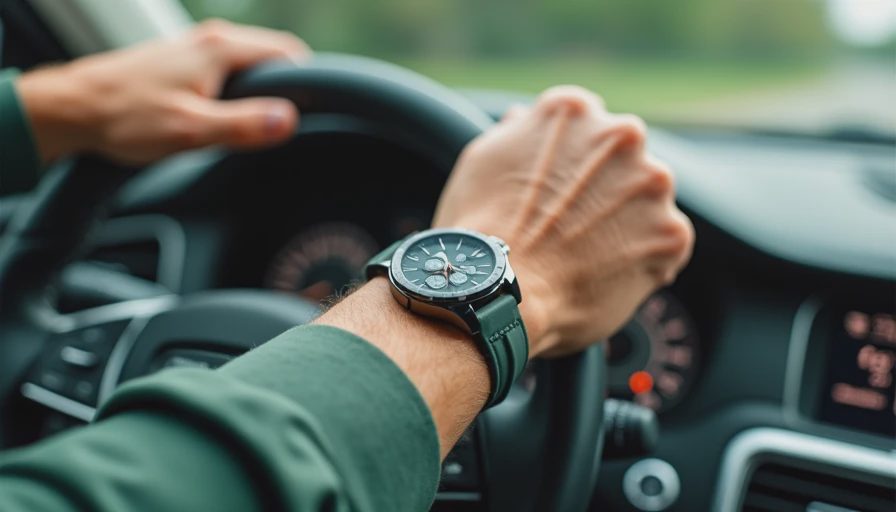
There is a moment when you glance from the road to your watch—perhaps at a stoplight, or while waiting for the engine to warm—and you feel a quiet satisfaction. The dial catches the early morning light in the same way the chrome trim on your car does. The weight of the case reminds you of the solidity of the gearshift. These are private pleasures, not ones you scream about. But they are precisely why the relationship between watches and cars endures. It is not about status or speed. It is about objects that help us mark time, beautifully and purposefully.
Perhaps the deepest connection between watches and cars lies in the way they mark time. A car carries you through your life, accumulating miles and memories. A watch runs alongside, measuring the hours and minutes of those journeys. Together they form a pair of sentinels—one on your wrist, one in the garage. The best watches for car enthusiasts do not shout. They keep time, and in doing so, they keep company. That is enough.